When searching for an export website development company, the goal is not to find a universal ranking. It is to find a partner that clearly delivers for your target markets, product information, inquiry journeys, and ongoing maintenance. Turn your purchasing requirements into a testable project checklist before comparing proposals and quotes. This helps avoid a website that looks attractive but nobody can update after launch. This article gives export managers a practical sequence for interviews, contracting, and acceptance checks. It does not include company rankings or performance promises that have not been verified firsthand.
Before the interview, turn “build a website” into specific tasks
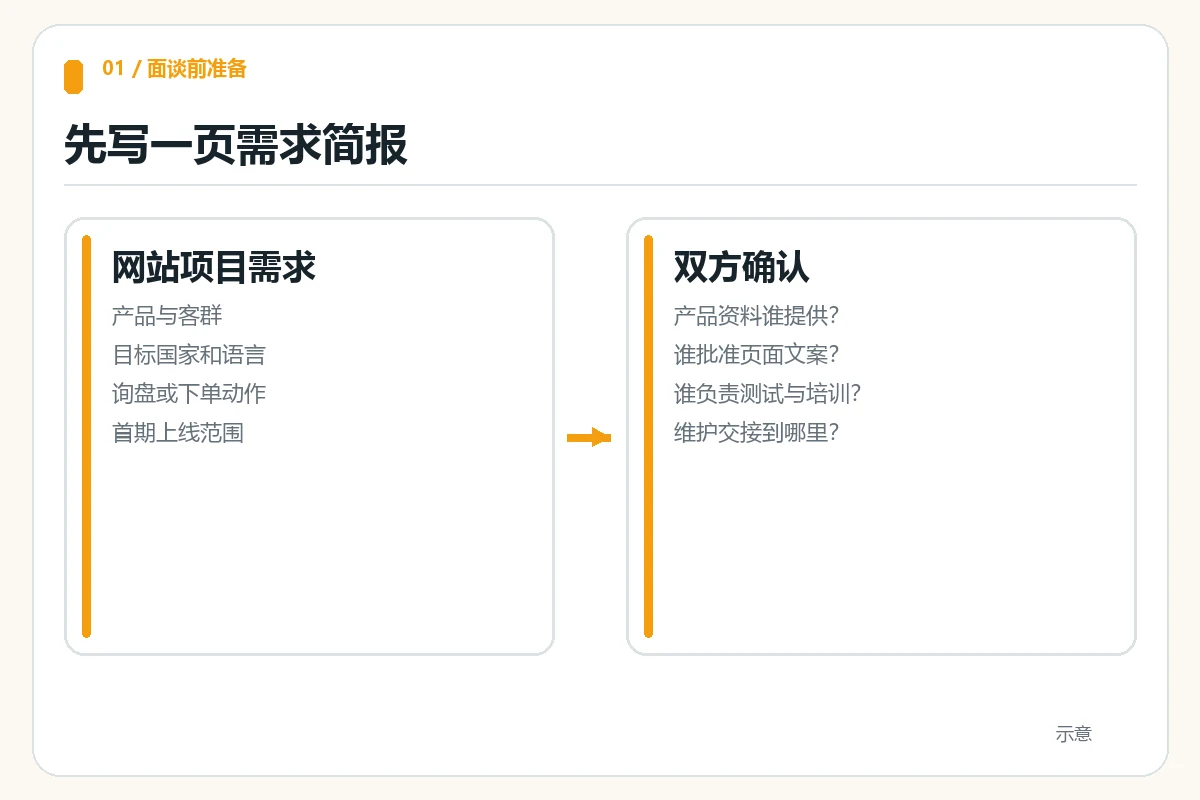
Prepare a one-page brief covering your main products, key buyer roles, target countries or languages, available product materials, planned launch date, and the visitor’s most important action: submitting an inquiry, downloading a catalog, contacting sales, or placing an order. Separate launch requirements from future extensions. For example, deliver the English website and product catalog first, then consider additional languages, customer accounts, or system integrations. This lets providers quote for the same scope. Without it, a lower quote may simply omit multilingual content, product entry, or ongoing maintenance.
Also appoint an internal project owner. The provider can design and develop, but your company must specify who supplies product specifications, reviews translations, confirms the receiving email address, and approves launch. Start with our homepage navigation and product-finding checklist to include frequently sought product lines and entry points in the brief; the lead coordinator performs the final public-access check for this internal link.
Compare export website companies through four capabilities
Ask case studies to demonstrate methods, not just screenshots
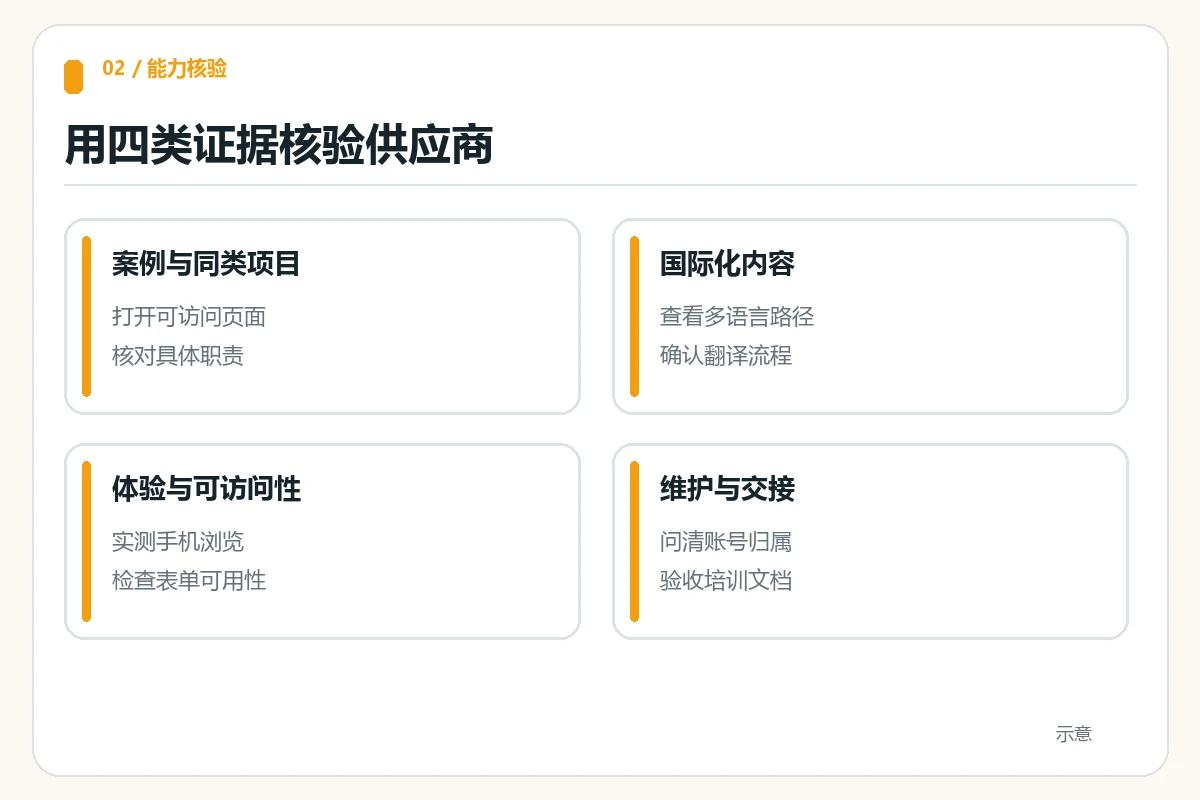
Ask shortlisted companies to show public websites with business complexity similar to yours. Have them explain the original goals, page structure, their own responsibilities, delivery boundaries, and results that remain accessible. A homepage screenshot reveals only a small part of the visual work. During the meeting, use a phone to follow the find-product, review-specifications, and submit-inquiry journey. Then check language switching, product filtering, form feedback, and page loading.
Make the proposal address target countries and content operations
Ask who translates and proofreads each language, which pages have separate URLs, how images and product terminology are localized, and who adds new products later. Google’s guide to managing multi-regional and multilingual sites recommends separate URLs for different language versions and explains how to identify those versions to search engines. Installing a translation plugin therefore cannot replace complete planning for content, URLs, and navigation. Ask for an editing demonstration using one product detail page and one article to confirm that your team can actually take over.
Clarify accessibility, maintenance, and ownership
Require acceptance criteria for mobile reading, keyboard operation, text contrast, and form error messages. W3C WAI’s website accessibility planning resources recommend including accessibility from the project-planning stage rather than adding it after launch. The contract should also identify who owns or controls domain registration, hosting, website administration, analytics tools, source files, and design files. If using WordPress, read our pros and cons of building with WordPress before asking the provider to clarify responsibilities for core software, plugins, backups, and recovery.
Compare proposals with one table, not just homepage design fees
The following table compares shortlisted providers’ delivery proposals; it is not an actual rating of any company. Ask every company to respond to the same columns. Mark unspecified items as “not committed,” rather than assuming they are included.
| Review area | Evidence to request | Common omissions and acceptance checks |
|---|---|---|
| Scope | Page list, languages, product-entry quantity, and feature list | Check off delivery page by page and feature by feature |
| Buyer experience | Prototype of the homepage-to-product-to-inquiry journey | Test navigation, forms, and error messages on a phone |
| Search and languages | URL structure, language versions, and editable metadata | Inspect representative pages and indexing settings |
| Handover and costs | Accounts, files, training, maintenance scope, and itemized pricing | Hands-on operation, backup recovery, and defect-fix deadlines |
Assess the total price together with hosting, paid components, translation and content entry , launch migration, and the maintenance period. If two quotes cover different scopes, align page counts, language counts, and acceptance criteria before discussing price. Treat promises of guaranteed Google rankings with particular caution. Google’s advice on hiring an SEO provider recommends asking about case studies, expected timelines, and measurement methods during interviews, and states that nobody can guarantee the top search position. Website development and SEO are related, but no provider can make rankings a guaranteed deliverable.
Perform reviewable acceptance checks at contracting and launch
Before signing: replace “we can do it” with specific deliverables
The contract appendix should at least list pages and templates, languages, content entry, form destinations, third-party components, the test environment, launch migration, training, and the maintenance period. For each milestone, specify deliverables, reviewers, revision rounds, and pass criteria. Request a project schedule showing when your company must supply materials and approvals. For inquiry-collection pages, also identify who configures and reviews data storage, permissions, and privacy notices. Confirm the specific compliance requirements separately for each target market.
Before launch: have business staff complete the entire journey
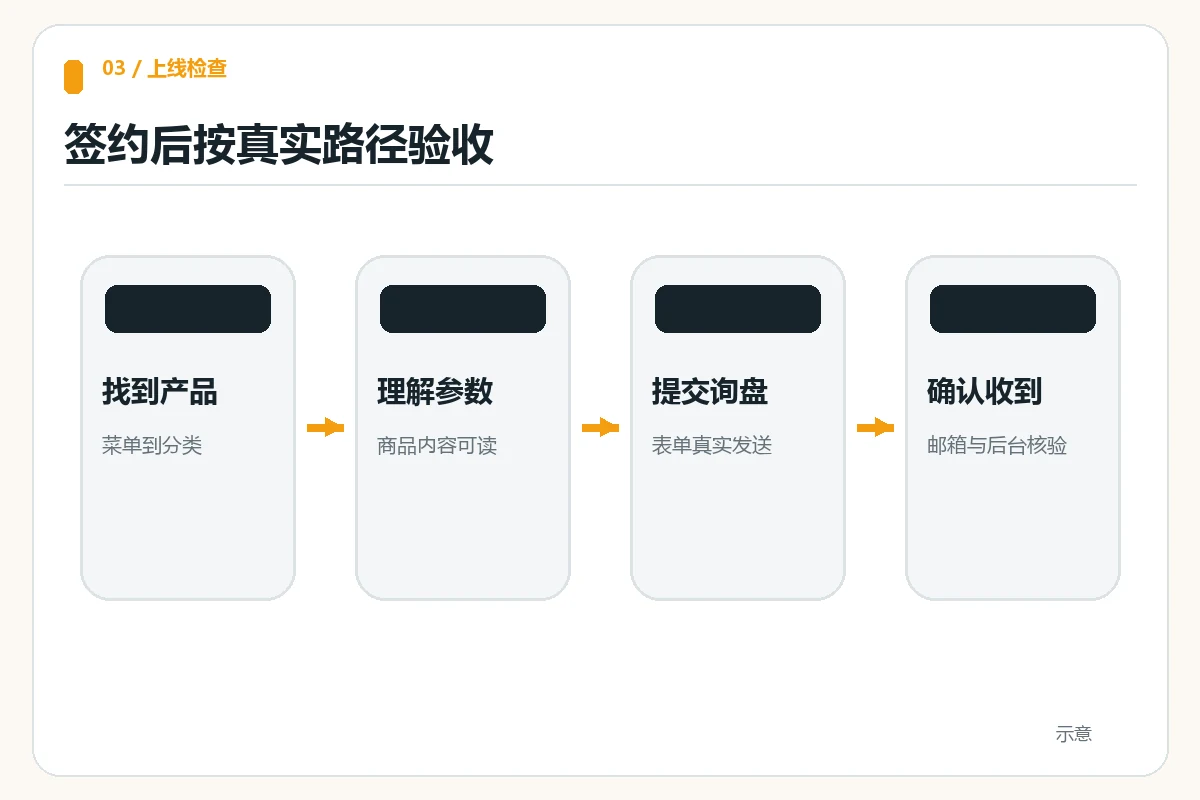
Do not rely only on a demonstration. Ask a salesperson who was not involved in production to use a phone to find a specified product from the homepage, review its specifications, and submit an inquiry clearly labeled as a test. Then confirm receipt by email or in the administration system. Next test another language, a search with no results, a form with an incorrectly completed field, and adding a product in the administration interface. Record screenshots, device, time, and results; assign an owner and retest date to each failure. W3C WAI implementation resources emphasize incorporating accessibility into development and testing. At handover, download website files and a data backup, and confirm that your company can log into the domain, hosting, and analytics accounts.
Conclusion: choose a working arrangement that can be verified
When choosing an export website development company, compare how each understands buyer tasks, implements multilingual content, delivers an editable website, and maintains it after launch . Start with a one-page brief, then ask two or three candidates to respond using the same checklist. Require public examples, itemized quotes, a realistic schedule, and executable acceptance-test steps.