Introduction
When creative brands grow, their websites often struggle to keep up.
As product lines expand, content increases, and traffic rises, many visually driven brands find that their original websites no longer support their business goals. Pages load slowly. Navigation becomes cluttered. Content updates turn into a bottleneck instead of a growth engine.
That was the situation for Tattly, a well-known temporary tattoo brand built around artist collaboration, playful storytelling, and strong visual identity.
Our role was clear from the start:
to help establish a scalable, flexible Shopify website foundation and support ongoing page design so the brand could grow without losing its creative soul.
This article walks through how we helped build and evolve Tattly’s Shopify website—from initial structure to long-term design support—and why a solid site framework matters just as much as great visuals.
| Deliver Time | Category | Application Platform |
| 23days | Temporary tattoos | Shopify |
| Designers Involved | Cost | Effect |
| Lin Zhang、Peifon FU | $2100 | Click-through rate📈241% |
Understanding the Brand and Business Goals
Before touching the website, we focused on understanding the brand itself.
Tattly is not just an online store. It’s a creative platform that connects artists, products, and customers through storytelling. Every tattoo set, collaboration, and collection carries personality, color, and emotion.
Key goals identified early:
- Support a content-rich eCommerce structure
- Maintain strong visual storytelling without overwhelming users
- Allow the internal team to update pages easily
- Scale product categories and collections without redesigning the site each time
- Create a foundation that supports future campaigns and promotions
These goals shaped every decision we made during the WordPress build.
Our Approach to Shopify Website Setup
Focusing on Structure First
Instead of starting with visuals, we began with structure.
A Shopify website works best when its foundation is clean, logical, and flexible. Our approach emphasized:
- Clear page hierarchy
- Modular layouts
- Reusable page sections
- Consistent content rules across templates
This ensured the site could grow without becoming difficult to manage.
Choosing Shopify for Flexibility and Control
Shopify offered the flexibility Tattly needed without locking the brand into rigid systems.
From a business perspective, Shopify allows:
- Easy content updates without technical dependency
- Scalable product and collection organization
- Editorial freedom for brand storytelling
- Long-term cost efficiency compared to fully custom platforms
Our role focused on configuring Shopify in a way that supports both marketing and daily operations—without requiring constant developer involvement.
Page Design Collaboration: Where Structure Meets Creativity
Designing Within a Scalable Framework
Once the site structure was in place, we moved into page design collaboration.
Rather than creating one-off designs, we focused on:
- Section-based layouts
- Repeatable visual patterns
- Consistent spacing, typography, and visual rhythm
This approach allowed new pages to feel fresh while still belonging to the same system.
Homepage: Balancing Promotion and Discovery
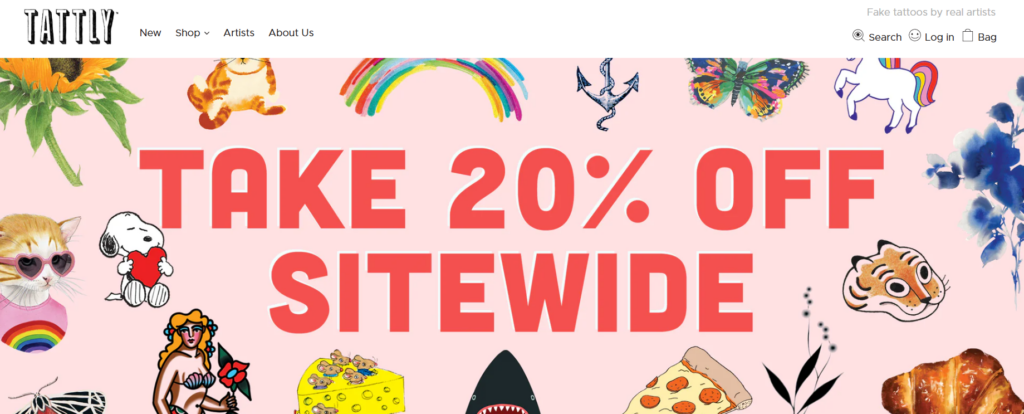
The homepage plays a critical role in brand perception.
For Tattly, it needed to:
- Highlight promotions without feeling sales-heavy
- Showcase artists and collections
- Guide users naturally into shopping paths
We designed the homepage as a flexible storytelling canvas—one that could change seasonally without rebuilding the entire layout.
Product and Collection Pages
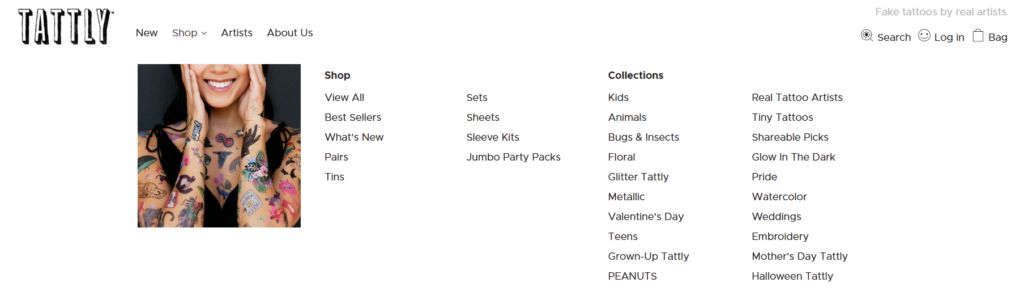
Product presentation focused on clarity and emotion.
We helped structure product pages to:
- Emphasize artwork and artist identity
- Keep purchase decisions simple
- Avoid clutter from excessive visual elements
Collection pages were designed as visual galleries rather than standard grids, allowing users to explore naturally.
Our Design Process in Practice
Step 1: Content Mapping
We mapped every page type before design began:
- Homepage
- Collection pages
- Product detail pages
- Content-driven sections
This prevented design inconsistencies later.
Step 2: Visual Hierarchy and Flow
We focused heavily on:
- Reading order
- Visual breathing room
- Clear calls to action
The goal was not to impress with complexity, but to guide users effortlessly.
Step 3: Modular Design System
By using modular sections, the brand could:
- Reorder layouts easily
- Test different page combinations
- Launch campaigns faster
This system saved time and reduced friction for future updates.
Challenges We Faced
Maintaining Visual Playfulness Without Chaos
With such a colorful and creative brand, the biggest challenge was restraint.
Too much visual energy can overwhelm users and hurt conversions. We solved this by:
- Using neutral backgrounds to anchor bold artwork
- Creating consistent spacing rules
- Letting artwork shine without competing UI elements
Designing for Growth, Not Just Launch
Many websites look great at launch but break under growth.
We planned for:
- Expanding product catalogs
- Seasonal campaigns
- Artist collaborations
- Ongoing content updates
That mindset shaped every layout decision.
Results and Outcomes
The final Shopify website delivered:
- A clean, scalable structure
- Strong visual consistency across pages
- Faster content updates for the internal team
- Improved user flow and product discovery
- A platform ready for long-term growth
Most importantly, the site became a creative asset—not a limitation.
Why Shopify Works for Creative eCommerce Brands
For brands like Tattly, Shopify offers a rare balance:
- Design freedom
- Content control
- Business scalability
When built correctly, it allows creative teams to focus on storytelling instead of technical constraints.
Conclusion
A successful Shopify website is not just about appearance—it’s about foundation.
By focusing on structure first and design second, we helped create a website that supports creativity, growth, and day-to-day operations. The result is a platform that evolves with the brand instead of holding it back.
At the end of the day, great websites are built at the intersection of strategy, structure, and design.
That philosophy defines how AIRSANG approaches Shopify website setup and page design—helping creative and eCommerce brands build platforms that look beautiful, work smoothly, and scale confidently over time.