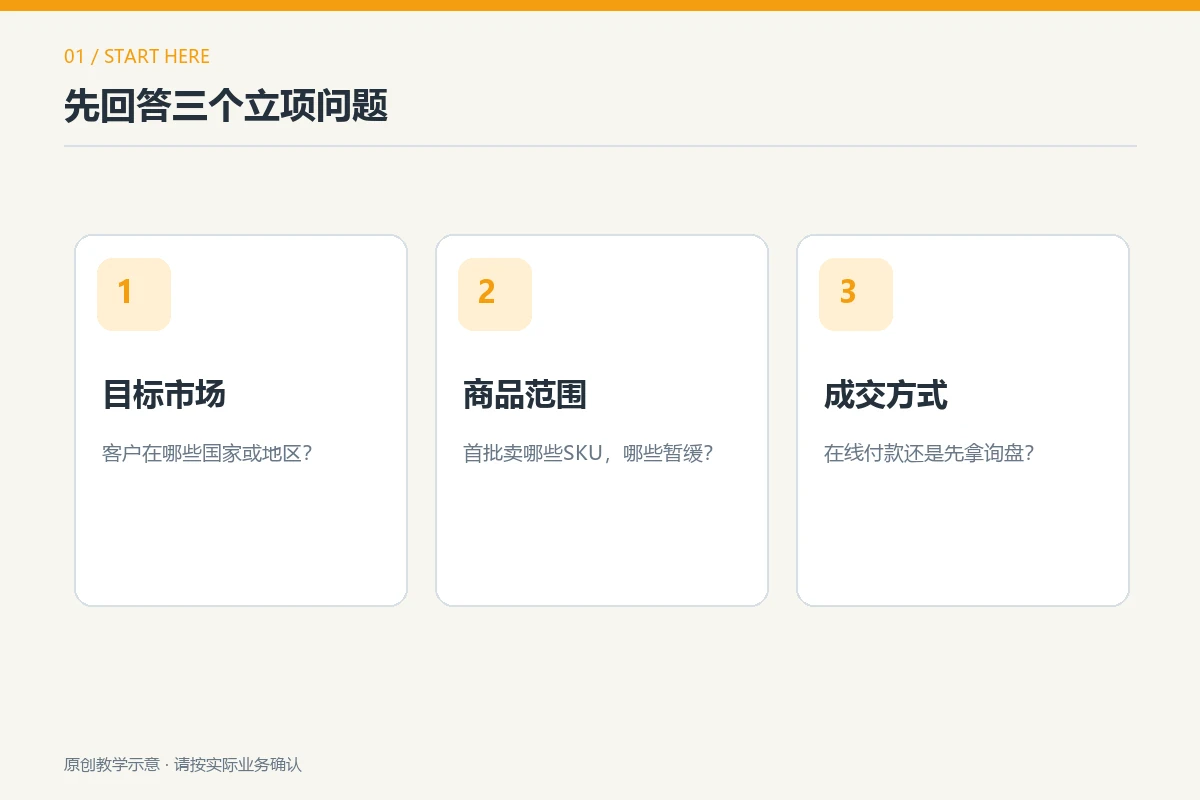
When planning a cross-border website, it is tempting to ask which platform to use first. Choosing a platform does not mean the site is ready to sell. Start with three questions: where will you sell, what will you sell, and how will buyers complete a transaction? The answers determine your payment, delivery, page, and customer service preparations.
The following checklist follows a first launch, separating what must be confirmed immediately, what depends on markets and products, and what can be improved later. It is a project planning checklist, not a universal legal or tax conclusion for every country.
Clarify Your Buyers, Products, and Transaction Process
A direct-to-consumer international store and a B2B inquiry website have different jobs. Retail customers need to pay after reviewing a product. B2B buyers may first download specifications and submit quantities and delivery requirements for a sales quote. A shopping cart is not the only measure of a cross-border website.
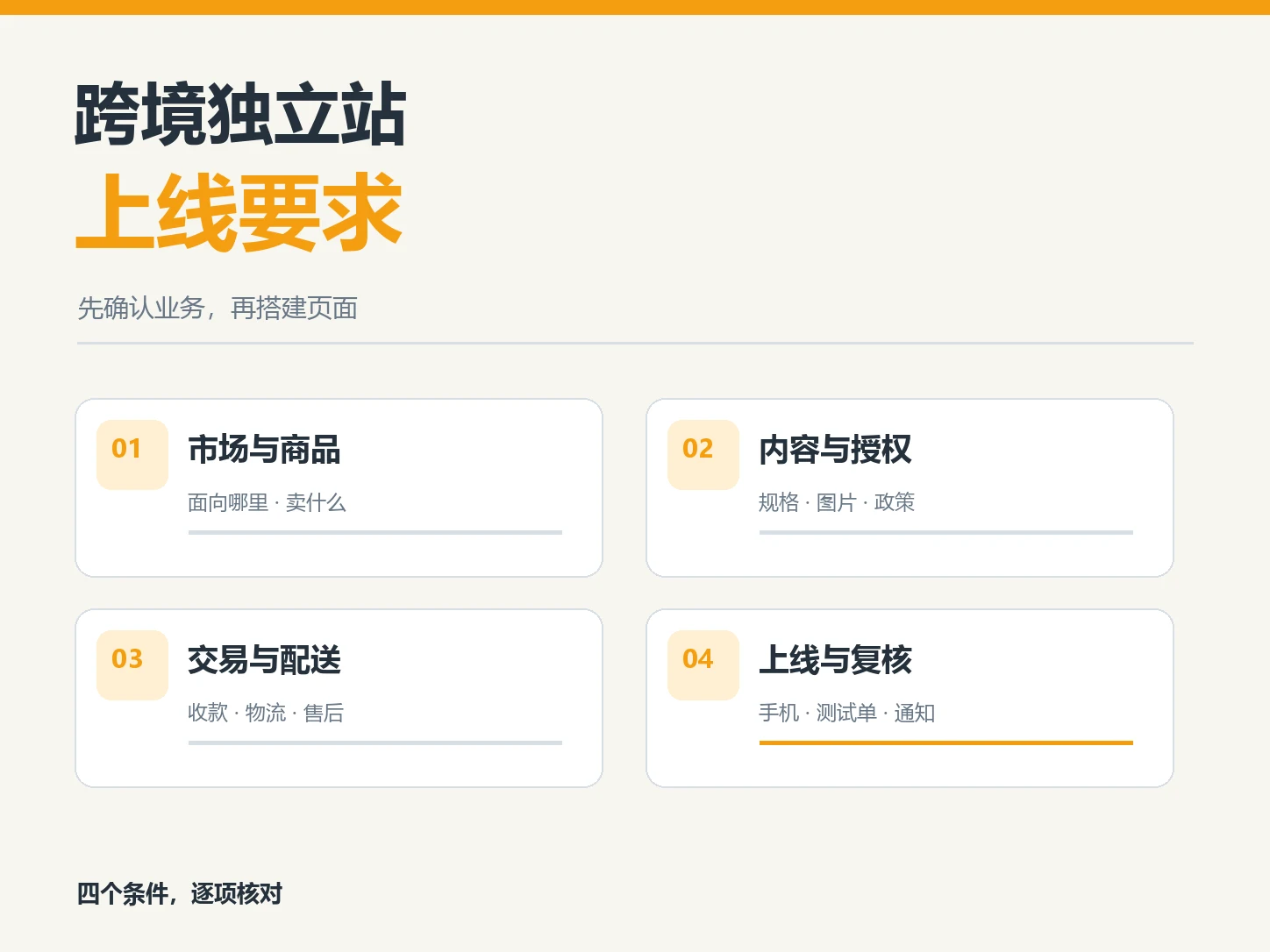
Before designing the homepage, the project owner should answer these four questions with sales, product, and support teams. Record the answers in a one-page brief to guide platform and page decisions.
- Which countries or regions are the main targets? Which will the first version cover, and which are excluded for now?
- What products will you sell? Are there dimensions, materials, certifications, shipping restrictions, or after-sales conditions to consider?
- Will customers pay directly or submit an inquiry and wait for a personal quote?
- Who ships orders, responds to customers, updates inventory, and handles returns and exchanges?
If you have not decided between a company showcase, inquiry site, or online store, first read how standalone websites and corporate websites differ in purpose . This article addresses what the first version needs once that direction is clear.
Prepare Product Information Before Judging the Design
Help Buyers Understand and Your Team Keep Content Updated
Listing a product takes more than one image and a price. Someone must confirm its name, specifications, dimensions or materials, packaging quantities, applications, and sales territories. Images should be clear, and usage rights confirmed: supplier images are not necessarily licensed for unrestricted advertising or overseas use.
Consider a desk lamp. Buyers may ask about plug standards, input voltage, replaceable bulbs, and dispatch times. If these answers exist only in support conversations, the page cannot help new customers decide independently. Start with a representative product, answer common questions thoroughly, and establish a reusable structure for the rest.
- Brand and product information: names, trademark ownership or usage rights, image permissions, models, variants, and accurate specifications.
- Transaction information: prices and currencies, inventory definitions, dispatch location, estimated delivery times, shipping charges, and returns.
- Service information: a working email or form, response languages, support hours, and the after-sales owner.
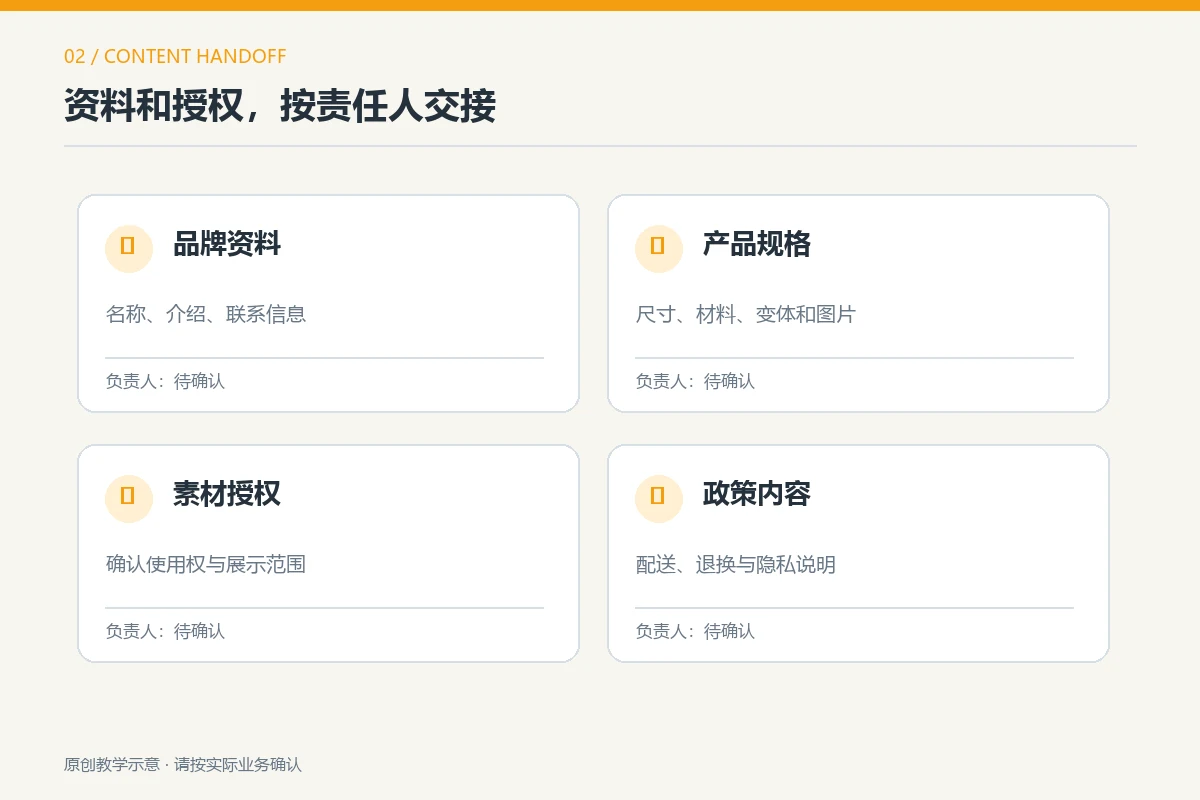
For a large catalog, create a handoff table for product staff to complete, operations to review, and editors to publish. For broader store preparations, see the online store launch checklist ; this article focuses on the additional market, language, and fulfillment decisions involved in cross-border selling.
Check Payment and Delivery Eligibility First
Payment Options Must Fit the Merchant and Buyer Locations
A payment button common on overseas websites may not be available to your business. Providers assess merchant registration location, business model, product category, and application documents; buyer location also affects available methods. Check current eligibility on the provider’s official website, then apply and test. Verify fees, exchange rates, and settlement times for your own merchant profile rather than budgeting from another company’s quote.
For payment options, see our guide to payments for international business websites . The decision here comes earlier: establish who receives funds, the display and settlement currencies, and who handles refunds. An inquiry site also needs clear quote currencies and subsequent payment procedures; do not add an unusable checkout merely to resemble a store.
Keep Shipping, Returns, and Support Information Consistent
Before ordering, buyers usually want to know whether delivery is available to their country, how shipping is calculated, how long it takes, and where returns go. Test the complete process in one or two main markets before expanding. Compare page promises with carrier coverage. Do not promise fixed delivery times for uncertain destinations or products.
Destinations may have different requirements for taxes, privacy, and product labeling. Ask professionals familiar with the local business to confirm applicable requirements and record who maintains them. Do not copy another merchant’s policies. Shopify’s general store setup checklist also separates setup, testing, and launch. Use its sequence as a reference while checking compliance for your own business.

Choose First-Version Pages Around Buyer Tasks
More pages are not automatically better. New visitors must understand what you sell, whether they can buy or inquire, how to contact you, and what happens if something goes wrong. Page names may differ, but essential answers must be accessible. This table helps define scope; it does not imply identical legal obligations for every product category.
| Priority | Buyer Questions to Resolve | Typical Location |
|---|---|---|
| Confirm for the First Version | What the product is, how to order or inquire, how to contact you, and how shipping and returns work | Homepage, product pages, contact page, shipping and returns information |
| Decide Based on the Business | How to switch between and explain markets, currencies, languages, or complex specifications | Region and language selectors, categories, specification pages |
| Improve After Launch | Which questions recur and which links visitors cannot find | FAQs, articles, navigation improvements |
Treating business-dependent requirements as something to postpone can also cause problems. If you sell into two different-language markets from day one, both audiences must understand checkout and after-sales information. Conversely, testing one market does not require ten empty language versions. Google’s SEO Starter Guide emphasizes content that users and search systems can understand. This is foundational work, not a guarantee of immediate rankings.
Test the Entire Journey Before Launch
A page loading successfully does not mean customers can buy. Start testing on mobile, where images, buttons, and forms are most vulnerable. Retail stores can place an order using an approved platform or payment-provider test method. Inquiry sites should submit a realistically formatted test request and confirm that it reaches the responsible person’s inbox.
- Open the homepage at a common phone size in the target market and find a specific product.
- Confirm the currency, specifications, shipping charges, and delivery regions before proceeding to checkout or inquiry.
- Submit a test order or form and check notifications, inventory changes, and administrative records.
- Follow the stated process to confirm who handles cancellations, refunds, or personal responses.
Test orders are not real transactions. Shopify’s official test-order instructions cover checkout, shipping, inventory, and notifications, and explain that test mode affects normal payments. Follow your platform’s official instructions and restore the ability to accept real orders afterward.
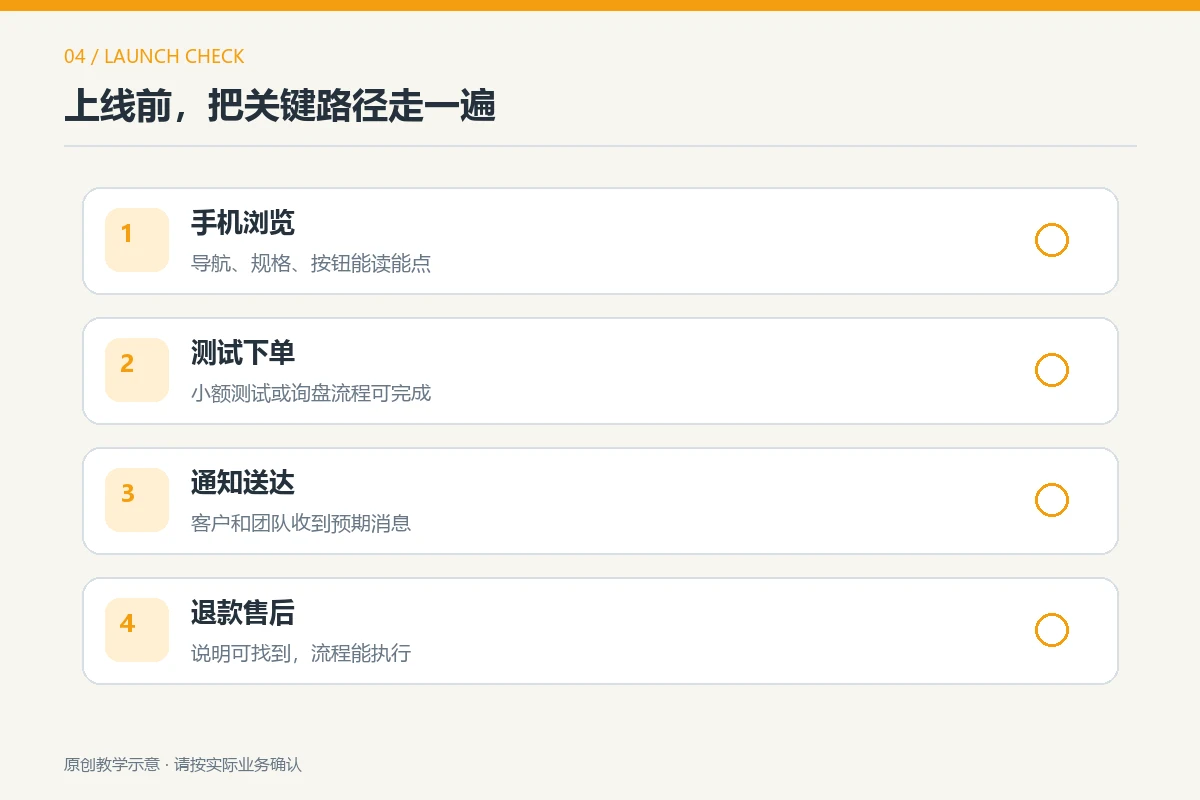
Finally, ask a colleague uninvolved in the build to repeat the task. If shipping information or contact details are hard to find, fix the pages before advertising. Record each obstacle, its owner, and the retest date; that is more useful than simply saying the site is live.
Conclusion: Turn Requirements into a Handoff Checklist
A cross-border ecommerce website starts with helping target-market buyers understand products, complete payment or inquiries, and find shipping, returns, and contact information—not choosing a theme. Confirm markets, products, payment eligibility, fulfillment, and essential pages, then complete an end-to-end mobile test.
If ownership is unclear, create a handoff table: who supplies product information, applies for payments, confirms delivery policies, and maintains the website? Resolve these questions before debating page counts and visual styles, and the project scope will be easier to define.