










Giỏ hàng hiện không có sản phẩm nào.

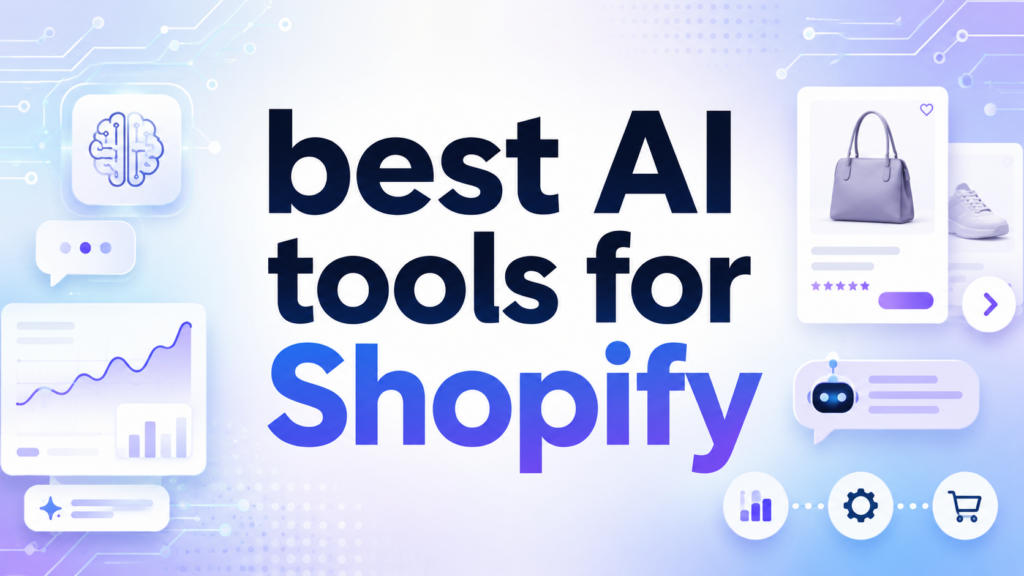
Artificial intelligence is quickly becoming part of everyday ecommerce operations. For Shopify merchants, AI is no longer limited to generating product descriptions or answering simple chatbot questions. Modern AI tools for Shopify can assist with store creation, email marketing, customer service, product recommendations, pricing, product research, and business analysis.
This change matters because running an online store involves far more than adding products and accepting payments. Merchants must attract visitors, understand customer behavior, answer questions, recover abandoned carts, manage promotions, study competitors, and continually improve the shopping experience.
AI can help automate many of these repetitive tasks while giving merchants more useful information for making decisions.
However, that does not mean every Shopify store should install every AI application available. The best strategy is to understand what each type of tool actually does and then choose technology based on the problems your store needs to solve.
This guide explains the most important categories of AI tools for Shopify, how they work, and when they can be useful.
AI tools for Shopify are applications or built-in features that use artificial intelligence to automate tasks, analyze data, generate content, predict customer behavior, or personalize the ecommerce experience.
Traditional ecommerce software usually follows fixed rules. For example, a standard email tool might send the same campaign to everyone on a mailing list.
An AI-powered system can go further. It may analyze purchase history, browsing behavior, engagement levels, and customer preferences before deciding which message to send and when to send it.
The same principle applies across other parts of ecommerce.
AI customer service platforms can recognize common questions and respond automatically. Recommendation engines can predict which products a shopper may want next. Pricing tools can monitor competitors and identify changes in the market.
The goal is not simply to automate more tasks. Good AI tools help merchants make ecommerce operations more efficient while improving the customer experience.
One of the easiest places to begin is Shopify itself.
Shopify has introduced native artificial intelligence features designed to help merchants create and manage their stores more efficiently. These capabilities include AI-assisted content generation, store-building support, and product-related insights.
For a new merchant, this can reduce the amount of time required to create basic ecommerce content.
Instead of writing every product description from scratch, for example, AI can help generate an initial version that the merchant can edit. Similar tools can assist with marketing copy and other routine content.
Native Shopify AI is particularly useful because it already exists inside the Shopify ecosystem. There is no need to create a complicated software stack before launching a store.
For beginners researching AI tools for Shopify, native features are therefore a logical starting point.
The important thing is still to review AI-generated material before publishing it. AI can speed up content creation, but brand positioning, product accuracy, and customer communication still require human judgment.
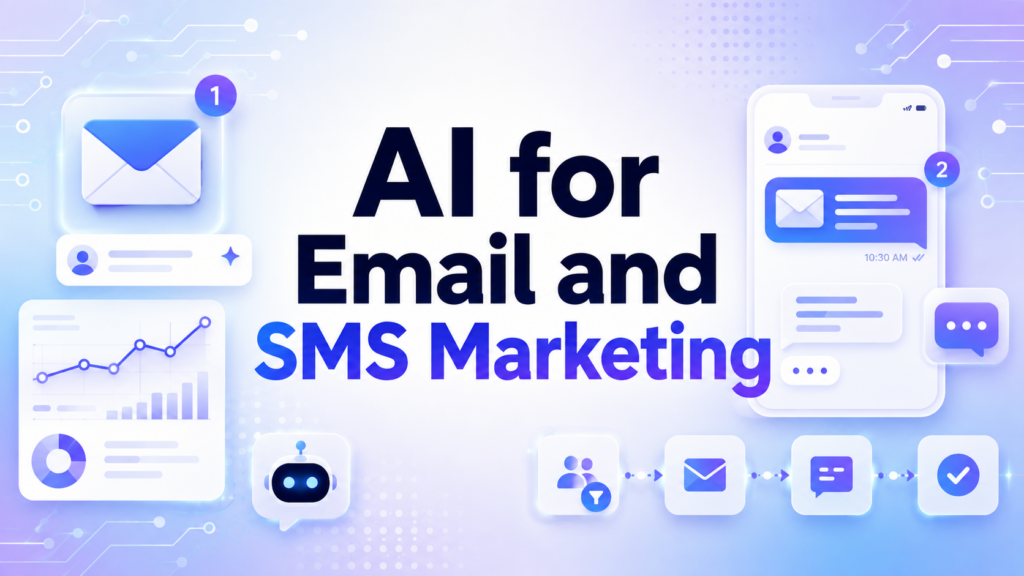
Email remains one of the most important channels for ecommerce retention.
Instead of relying entirely on manual newsletters, AI-powered marketing platforms can help merchants identify audiences, predict customer behavior, optimize campaign timing, and automate different communication flows.
Klaviyo is one of the most widely used examples in the Shopify ecosystem. Its AI capabilities include predictive analytics, segmentation, send-time optimization, and assistance with marketing content such as subject lines.
The real value of this technology becomes clearer when looking at customer journeys.
Consider a shopper who visits a Shopify store, views three products, adds one item to the cart, and leaves without completing the purchase.
A marketing automation platform can place that shopper into an abandoned-cart sequence. Another customer who has purchased several times may receive a completely different message, such as a product recommendation or loyalty offer.
AI helps make these communications more relevant.
For many growing stores, three automated email journeys are especially important:
Merchants do not necessarily need dozens of campaigns. A smaller number of well-designed automations can often provide more value than a large number of poorly managed ones.
Customer service can become difficult to manage as order volume increases.
Many ecommerce questions are highly repetitive:
“Where is my order?”
“Can I return this product?”
“When will my package arrive?”
“Can I change my shipping address?”
Without automation, support teams may spend hours answering variations of the same questions.
AI customer service tools can reduce this workload.
Gorgias, for example, is designed specifically around ecommerce support and integrates with Shopify store information. It can bring order information into customer conversations and automate responses to common support requests.
Tidio offers another approach, particularly for smaller ecommerce businesses. It combines live chat with AI-powered chatbot capabilities, allowing automated systems to answer common questions while sending more complicated requests to human support.
For international ecommerce businesses, platforms such as QuickCEP focus on AI-based customer interactions across different markets.
The most important principle is not to automate every conversation.
Customers with unusual order problems, payment disputes, damaged products, or complicated requests may still need a real person.
The strongest AI support systems therefore include a clear human handoff process.
Traditional ecommerce websites often show nearly identical pages to every visitor.
AI personalization changes that model.
A personalization engine studies behavioral information and uses it to decide which products, collections, or offers may be most relevant to a particular shopper.
Nosto is one example of this category. It provides ecommerce personalization capabilities including product recommendations, personalized content, and dynamic merchandising experiences based on shopper behavior.
Rebuy focuses more specifically on Shopify merchandising, including recommendations around product pages, carts, and checkout-related experiences.
Imagine that someone is purchasing a camera.
A recommendation system might identify that customers buying the same camera frequently purchase a memory card, battery, carrying case, or tripod.
Instead of displaying random products, the store can present items that have a stronger relationship to the shopper’s current purchase.
This can improve product discovery and potentially increase average order value.
However, personalization becomes more useful when a store has enough traffic and customer behavior data to analyze. A brand-new store with very little activity may benefit more from focusing first on traffic generation, product positioning, and basic conversion optimization.
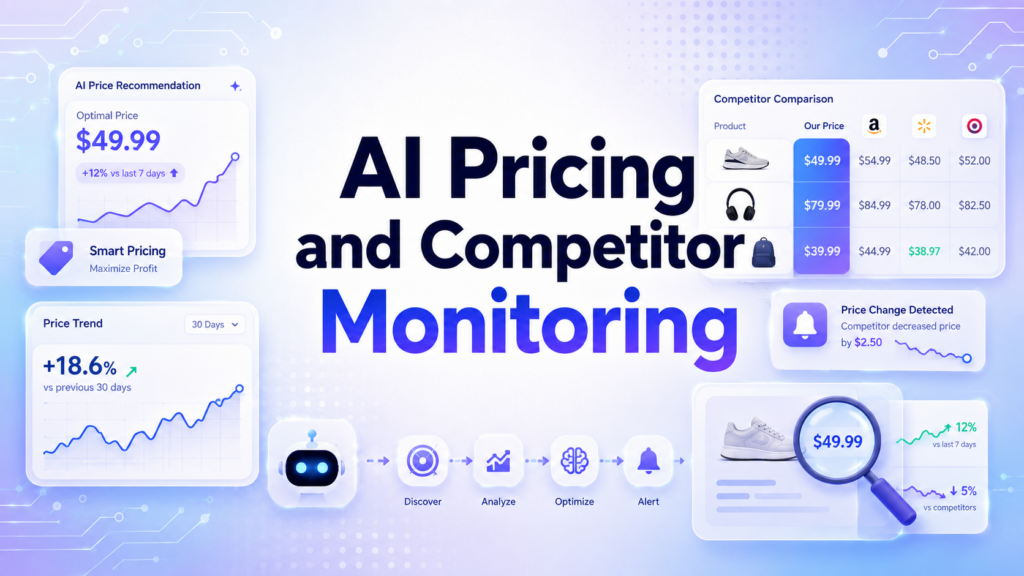
Pricing becomes increasingly complicated in competitive product categories.
Merchants must understand not only their own costs and margins but also how competing stores are positioning similar products.
AI-supported pricing and competitor-monitoring platforms can make this process easier.
Prisync, for example, helps ecommerce businesses track competitor prices and manage pricing decisions based on market information.
This does not mean every merchant should automatically offer the lowest price.
A premium brand may intentionally charge more because of better materials, stronger service, faster delivery, packaging, warranties, or brand positioning.
The real value of competitor monitoring is visibility.
If competitors suddenly reduce prices, launch promotions, or change their positioning, merchants can identify those changes without manually visiting dozens of websites every day.
For highly price-sensitive categories, this information can become particularly valuable.
Dropshipping merchants face another major challenge: deciding what to sell.
Thousands of potential products may be available through suppliers and marketplaces. Manually researching demand, competition, pricing, and product trends can require significant time.
This is where product-research tools can help.
FindNiche, for example, focuses on niche and product discovery across ecommerce and dropshipping environments.
AI can help merchants organize large amounts of information and identify products that may deserve additional investigation.
However, merchants should avoid treating AI product recommendations as guaranteed winning products.
A tool cannot completely predict future consumer demand.
Successful product selection still depends on factors such as:
AI can reduce research time, but it should support product decisions rather than replace them.
Competitive research often involves gathering information from many different websites.
A merchant may want to compare competitor prices, customer reviews, product specifications, collections, or promotional strategies.
Manually transferring all of this information into spreadsheets is inefficient.
Data extraction tools can help automate the process.
Thunderbit, for example, provides AI-assisted web data extraction that can turn information from websites into structured datasets. Shopify merchants may use this type of technology when researching competitors, reviews, products, or pricing.
The advantage is not simply collecting more data.
Structured information is easier to compare.
A merchant could create a spreadsheet showing dozens of competing products with fields such as:
Product name, price, discount, rating, review count, category, shipping information, and key features.
That creates a much clearer view of a market than randomly browsing competing stores.
The large number of available Shopify apps can make it tempting to install everything.
That is usually unnecessary.
Every additional application introduces another subscription, configuration process, dashboard, and possible impact on store performance. The original FlowCay guide similarly warns against installing too many partially configured apps and recommends building an AI stack gradually.
A better approach is to identify the biggest bottleneck in the business.
A new store should prioritize the fundamentals.
Start with Shopify’s native AI features for basic content and store-management assistance. Then consider simple email automation and customer chat.
At this stage, complicated personalization or competitor-pricing systems may not provide enough value.
As sales increase, customer communication becomes more important.
This is often the point where advanced email automation and customer support systems become valuable.
More visitors generate more abandoned carts, customer questions, repeat purchases, and customer data.
AI can help organize these activities.
Stores with larger traffic volumes can begin exploring deeper personalization.
Recommendation engines, automated merchandising, predictive marketing, and competitive pricing intelligence become more useful when enough behavioral data exists to support them.
Cross-border ecommerce creates additional complexity.
Merchants must manage customers from different regions, languages, time zones, and shopping expectations.
Multilingual AI support, localization tools, international marketing automation, and structured competitive research can become particularly useful for these stores.
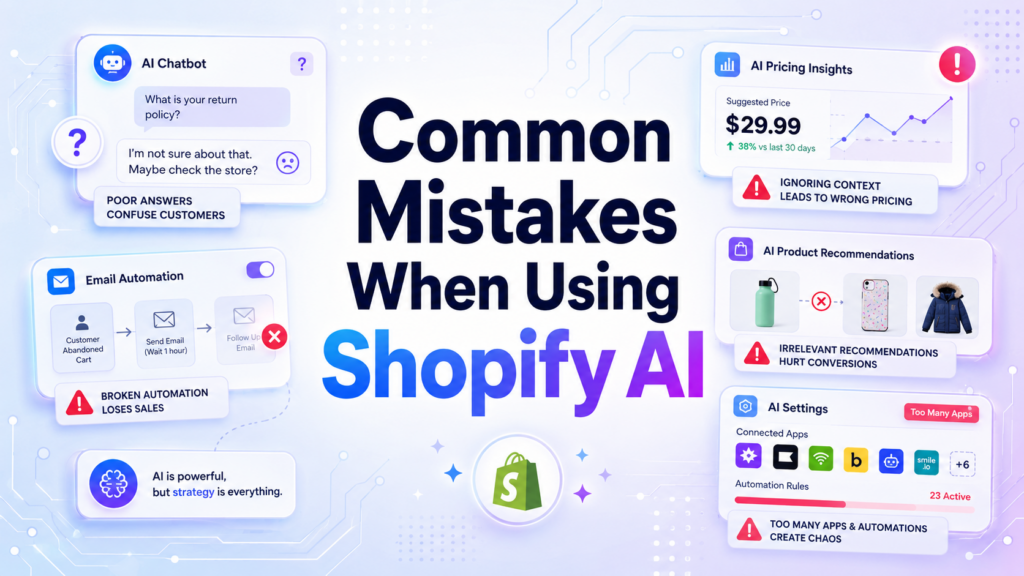
AI can improve ecommerce operations, but poor implementation can create new problems.
One common mistake is installing too many applications at once.
Merchants sometimes believe more automation automatically means better performance. In practice, overlapping tools can increase costs and make store management unnecessarily complicated.
Another mistake is expecting AI to create the entire business strategy.
For example, an AI email platform can automate a campaign, but the merchant still needs to understand the audience, offer, product, and reason for sending the message.
The same applies to customer service.
A chatbot can answer common questions, but poorly designed automation can frustrate customers when they cannot reach human support.
Merchants should also regularly review app performance.
Ask simple questions:
Is this tool saving time?
Is it increasing revenue?
Is it improving customer experience?
Is the data actually useful?
Would the business perform differently without it?
If the answer is consistently no, the application may not deserve a place in the store’s technology stack.
There is no universal combination of AI tools for Shopify that works for every business.
A fashion brand, electronics store, dropshipping business, niche boutique, and international retailer all have different priorities.
Instead of choosing tools because they are popular, build your AI stack around business problems.
A simple structure might look like this:
Foundation: Shopify’s native AI features.
Customer retention: An email and SMS automation platform.
Customer communication: An AI support or live-chat system.
Conversion optimization: Product recommendations and personalized merchandising.
Market intelligence: Competitor pricing and data-research tools.
Product discovery: Research tools for merchants that depend heavily on sourcing or dropshipping.
Most stores will not need every category immediately.
The correct stack should evolve as the business grows.
AI will likely reduce the amount of manual work involved in ecommerce, but that is different from removing humans entirely.
AI is strongest when handling repetitive, data-heavy, and predictable activities.
It can generate first drafts, categorize customers, identify patterns, answer routine questions, recommend products, collect information, and trigger automated workflows.
Humans remain important for areas requiring judgment.
Brand strategy, creative direction, customer empathy, product selection, pricing strategy, merchandising decisions, and unusual customer situations still benefit from human involvement.
The more useful way to think about AI is therefore not “AI versus people.”
It is “people working with better tools.”
A merchant who previously spent several hours manually organizing customer data may be able to use AI to complete the same preparation much faster and spend more time interpreting the information and making decisions.
AI tools for Shopify are becoming an increasingly important part of modern ecommerce. They can support store creation, email marketing, customer service, personalized recommendations, competitive pricing, product research, and data analysis.
However, successful AI adoption is not about installing as many applications as possible.
The best approach is to identify the biggest operational problems in your Shopify store and introduce tools that solve those problems one at a time.
New stores can begin with native Shopify AI and basic marketing automation. Growing stores can add stronger customer support and lifecycle marketing. Larger stores may benefit from personalization, pricing intelligence, and advanced research tools.
AI works best when it removes repetitive work, organizes complex information, and helps merchants make better decisions. Used carefully, it can make Shopify operations more efficient without replacing the strategy, creativity, and human judgment required to build a successful ecommerce business.
The best AI tools for Shopify depend on your business needs. Popular options include Shopify Magic for content creation, Klaviyo for email marketing, Gorgias for customer support, Nosto for personalization, and Prisync for competitor price monitoring.
AI tools can help Shopify merchants automate repetitive tasks, improve customer service, personalize product recommendations, optimize email campaigns, monitor competitors, analyze data, and create marketing content more efficiently.
Yes. Many AI tools for Shopify are designed for beginners and require little technical knowledge. New merchants can start with Shopify’s built-in AI features and simple marketing or customer service automation before adding more advanced tools.
AI tools can support sales growth by improving product recommendations, recovering abandoned carts, personalizing marketing messages, optimizing pricing, and helping customers find relevant products. Results still depend on product quality, traffic, pricing, and overall store strategy.
Not necessarily. It is usually better to start with a few tools that solve specific problems. For example, you might use one tool for email marketing, one for customer service, and another for product recommendations as your store grows.
AI can automate many repetitive and data-heavy tasks, but it does not replace human strategy and judgment. Merchants still need to make decisions about branding, products, pricing, customer experience, creative direction, and overall business growth.