When preparing to sell an English Shopify store to France and Canada, don’t rush to install a translation app yet. First determine which countries to serve and which languages to provide, then select the URL that each version can open directly, and finally check whether the products, delivery and policies are really suitable for local buyers. For most businesses that are expanding into overseas markets for the first time, they can first evaluate the sub-directories under the same main domain name; when there are already independent national brands, domain names and maintenance teams, then compare sub-domain names or independent domain names. The “market” here refers to the sales arrangement for a certain country or region, and the “language” refers to the text used on the page; two markets can share a language, and the same market may also require multiple languages.
First, clearly list the market, language and operating conditions
Before starting to build the Shopify multilingual brand website, make an internal worksheet: write a target market in each line, record the buyer’s common language, checkout currency, available products, delivery range, shipping costs and estimated delivery instructions, return address and customer service language. For example, both France and Canada may require French, but their prices, delivery commitments, and policy text may not be the same. Just changing the English button to French does not mean that the sales preparation for the French market has been completed.
At what point will a buyer discover a mismatch in information?
Go through the homepage, category pages, product pages, shopping cart, and pre-checkout pages. Buyers check size units, variant names, available inventory, tax reminders, shipping costs, and return options. Divide these contents into three categories: “text can be translated”, “needs to be rewritten according to the market” and “must be confirmed by actual performance capabilities”: size explanation may require local expression, and the return period and delivery scope must be consistent with the merchant’s real rules. Language tools cannot decide for you whether you can ship to a certain country.

Shopify multilingual URLs: subdirectory, subdomain, or separate domain?
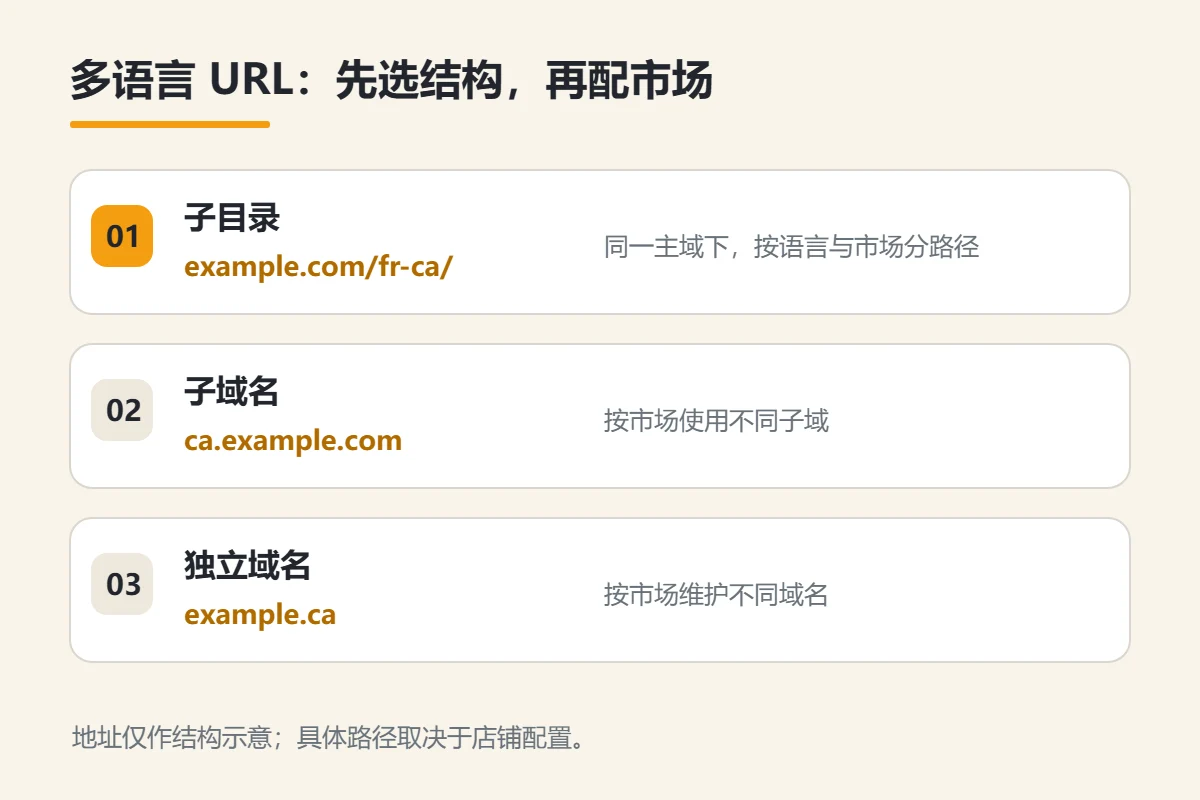
The URL is the page address in the browser address bar. Shopify officially supports arranging subdirectories, subdomains or independent domain names for the market. Examples are as follows; the actual path will be affected by the store language, region and configuration, and the example cannot be /fr/ As a fixed suffix for each store. The structure and configuration requirements of the following table are based on Shopify marketplace domain and language descriptions , applicable suggestions are editorial judgments and are not guarantees of search rankings.
| structure | Example | Configuration and maintenance | Applicable situations and migration reminders |
|---|---|---|---|
| subdirectory | example.com/fr/ | If you continue to use the main domain name, there is usually no need to register a domain name; centralized maintenance is more convenient. | Prioritize evaluation during initial expansion; check old URLs and jumps before changing paths. |
| subdomain | fr.example.com | The corresponding subdomain name and DNS need to be configured and maintained. | Consider when market addresses need to be clearly separated; check links, sitemaps and jumps when changing structures. |
| Independent domain name | example.fr | Domain names need to be obtained, connected and continuously managed separately. | Evaluate when there is a clear local brand or domain name strategy; check the old and new addresses page by page when migrating. |
When choosing, first look at whether the team can maintain the content and domain name for a long time, rather than just asking which structure has the “highest weight.” Subdirectories are usually simple to configure and are suitable for verifying the market first; independent domain names can give specific countries clearer address identification, but will increase domain name management work. No matter which one you choose, record the old address, new address, corresponding language and person in charge. If the market is closed or the structure is changed in the future, the original links may become invalid, so redirections and on-site link updates need to be arranged in advance.
Configure languages and markets sequentially in Shopify Markets
A safe sequence is: first confirm that the store plan and theme support the required functions, then add languages in the store settings, prepare for translation, and finally specify the URL structure and language for the target market. Shopify official steps It is required to add a language before it can be assigned to the market; the backend entrance and available options are subject to the merchant’s current store. Don’t interpret “the market has been created” to mean “all pages have been translated.”
Automatic translation can start, but it needs to be reviewed page by page before publishing.
Shopify’s Translate & Adapt can be used to translate and tailor content to market, but automatic translation cannot replace human proofreading of product terminology, sizing, policies, and promotional copy. Especially check the end of the page address URL handle (For example, the short name used to identify the product in the product path): Press Shopify Translate & Adapt Instructions , the handle is not within the scope of automatic translation and needs to be added manually; when a certain translation is missing, the page may also fall back to the main language of the store. Before publishing, you should directly open the target language URL, see the actual output, and then decide whether to go online.
Also check banners, reviews, and pop-up text in themes and third-party apps. Changing theme content by market is subject to package and theme restrictions, and should be verified in the current backend first.
After translation, what content needs to be localized?
“Localization” is about adapting content and purchasing experience to the target market, not just sentence-by-sentence translation. The homepage should allow local buyers to quickly understand the product and delivery scope; the navigation and category names should conform to local search and browsing habits; the product title, material, size, variant name and text in the picture should be consistent. yesterday’s Shopify Product Page Design Checklist After discussing the display of images, variations and purchase information, the focus of this article is to check whether the content is still accurate after placing the same purchase path in different languages and markets.
Take a common scenario: the purchase button on the French product page has been changed to French, but the size chart still uses English abbreviations, the shipping instructions only say “domestic delivery”, and the return page also points to the English website. Buyers may be able to click to place an order, but have no way of knowing what they will receive, when they will receive it, or how to return it. When repairing, first confirm the true policy and performance scope, and then change the corresponding language page; do not translate unconfirmed delivery time or tax commitments into confirmed wording.
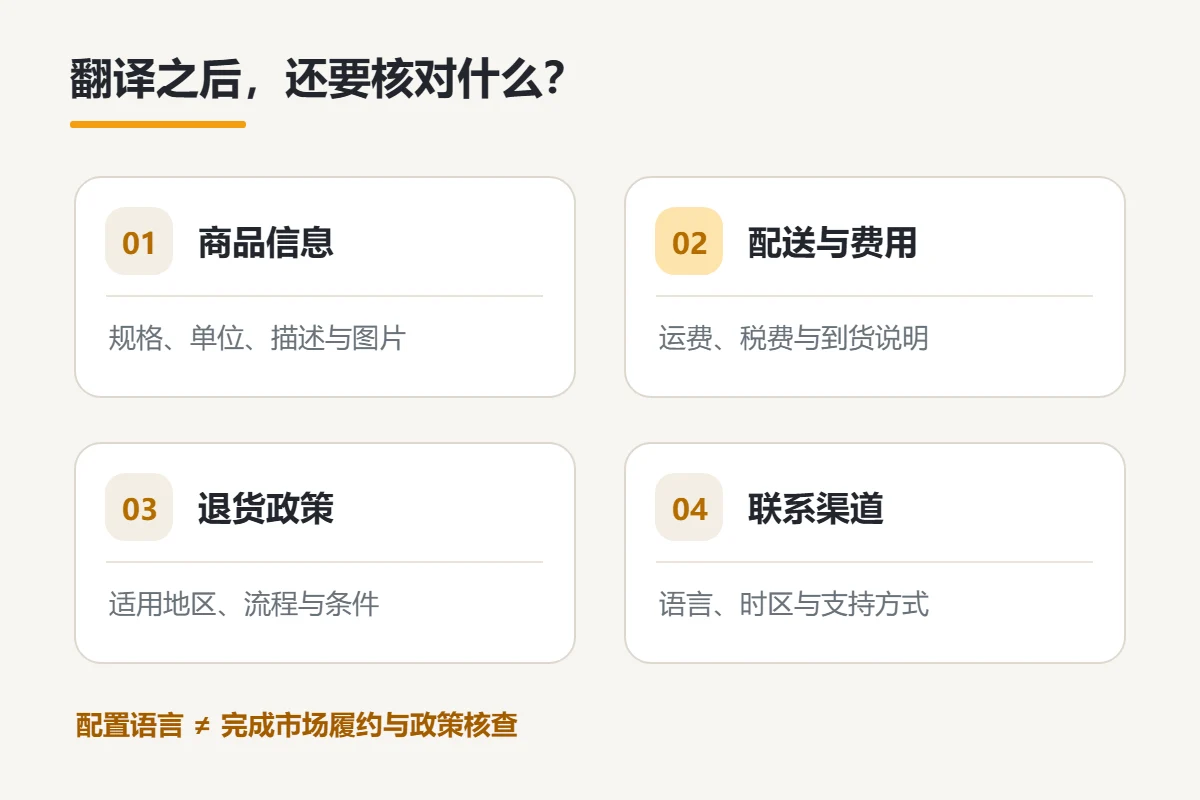
Also check price and currency display, offer thresholds, contact form, order notifications, SEO title and summary, image alts, and prompts embedded in the app. Third-party applications that do not support local languages may require additional configuration. If the same language serves multiple countries, policies and prices may still be different; conversely, the same country may also require multiple languages. These differences should be verified by both the market table and the actual page, not inferred from a switch.
How to check the search entrance and purchase path before going online?
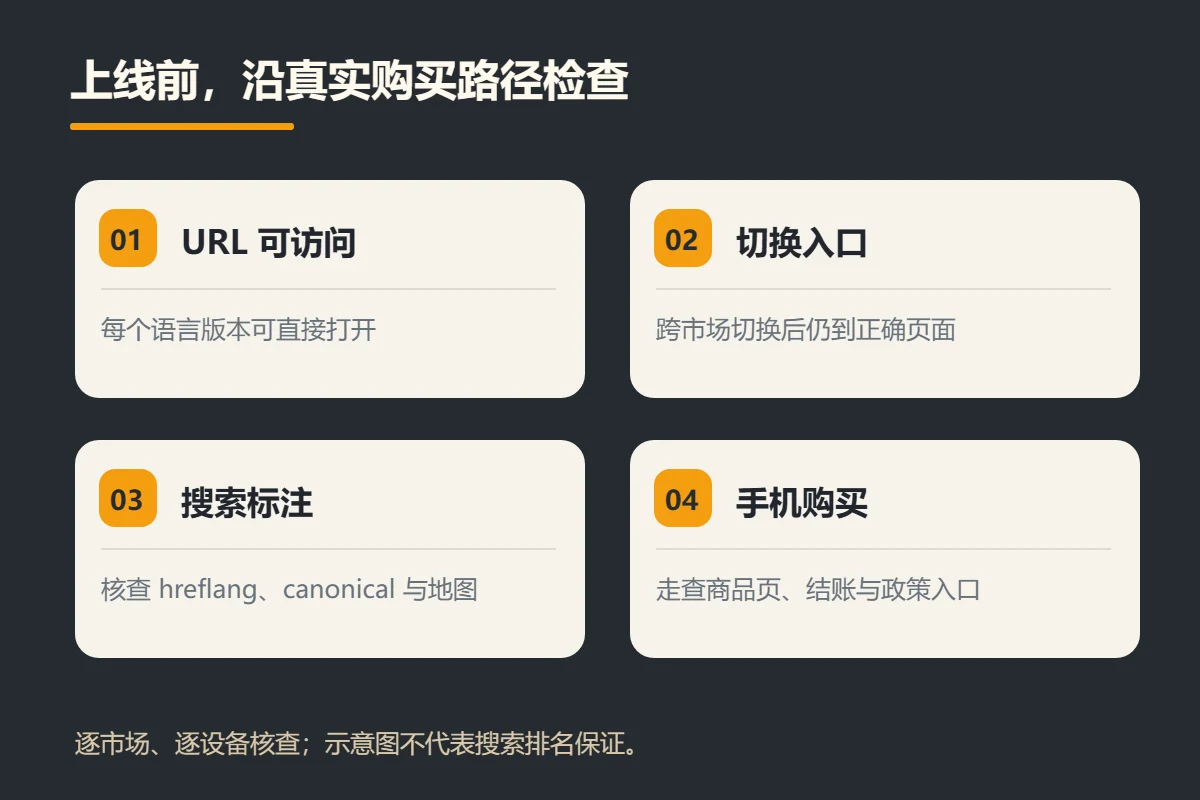
First, use a non-logged-in window to directly open the homepage, category page and a representative product of each target language. Confirm that the addresses are different, the main language of the page is correct, and the products are available for purchase; after jumping from the language switcher, it is best to stay on the corresponding product or equivalent page. Then use your mobile phone to check the navigation, line wrapping of long words, prices and purchase buttons, and actually go one step before checkout. Any location where “French is displayed, but the next page returns to English” should be documented with the specific URL and steps to reproduce.
Search to check for three more things: hreflang It is a tag that tells search engines which language or regional versions of the same content are available; canonical Is the canonical URL declared by the page; sitemap A list of URLs for search engines to discover pages. Shopify International SEO Documentation Note that after configuring different market URLs and languages, the corresponding signals can be automatically output; if multiple markets share the same URL and there are no language or regional differences, there will be no alternative addresses for mutual reference. If a topic or application adds similar tags on its own, it will also be randomly checked for duplication or conflict.
Google Guide to Multilingual Sites It is recommended to use different URLs for different language versions, and be reminded that switching content only by browser language or automatic jump may make some versions difficult to discover. When checking, make sure that the search crawler can access the target page and not just see the correct results in your own browser. hreflang helps match versions and does not guarantee that a page will be included or ranked. Even if the platform automatically generates a site map, you should still check the actual URL, canonical address and index status after going online; it can be combined when system troubleshooting is required SEO optimization services Do a page-by-page verification.
Conclusion: Make a maintainable version first, and then expand the market
The order of building a Shopify multilingual brand website is to first clarify the market and fulfillment capabilities, then determine the directly accessible language URL, then review the content and purchase path, and finally check the search signals. When expanding into multiple markets for the first time, subdomains are usually worth evaluating first; if there is an independent national brand or clear market isolation needs, then compare subdomains with independent domain names. URL schemes by themselves cannot remedy wrong sizing, vague return instructions, or unfulfilled delivery promises.
If you are planning a new website or revision, you can sort out the target country, required language, existing domain name, product catalog and actual delivery range, and hand it over to Shopify e-commerce website construction team Evaluate URL architecture, content effort, and rollout scope. This discussion will be about executable pages and processes, not just “adding a language button”.