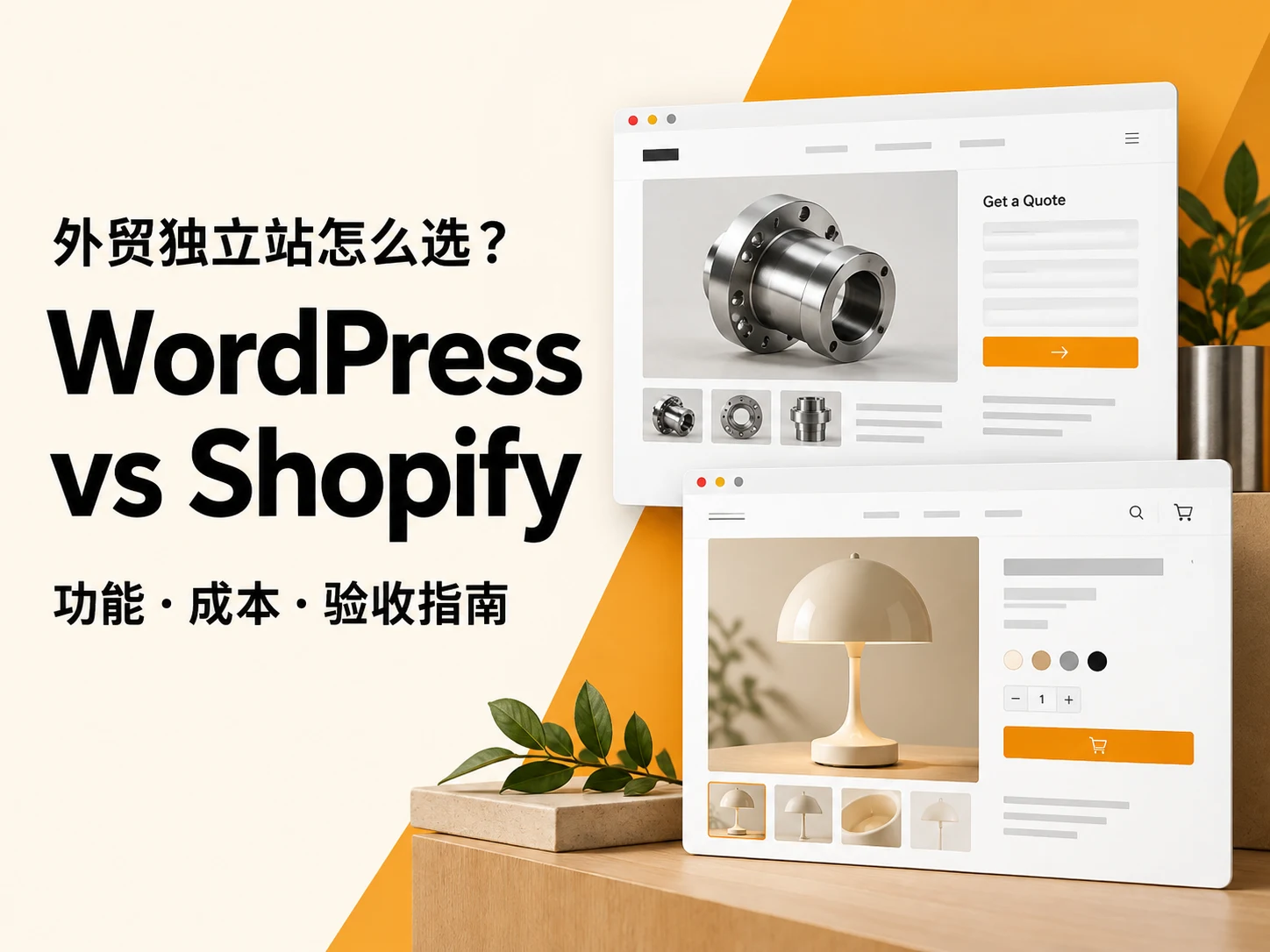
When choosing WordPress or Shopify for a international business website, you should first consider how the customer completes the transaction: submit purchase requirements, pay online, or repeat orders at the agreed price? Platform names are not a substitute for business solutions. This article starts from customer inquiry, functional boundaries and long-term investment to help foreign trade companies determine the website development route that suits them.
1. First clarify the transaction path of international business website
Customer inquiry type: Let purchasing personnel judge supply capabilities
Purchasers of equipment, parts and custom processing often need to confirm specifications, materials, minimum order quantities, delivery dates and application conditions. The website should clearly organize product categories, technical information, corporate capabilities and contact information, and then provide a concise customer inquiry entry. The customer inquiry form must actually be delivered to the person in charge’s email address, and the feedback after submission should also be clear.
For example, a parts purchaser may first filter by application, then review drawings, dimensions and materials, and finally ask if it can be customized based on samples. The page should support this sequence instead of requiring the other party to check out directly when there is insufficient information. Here are examples of business scenarios, not customer performance.
Retail vs. Wholesale: Verify Payment and Repurchase Process
Standard product malls should focus on checking specification selection, inventory, shopping cart, shipping costs, and payments; wholesale businesses may also require company accounts, quantity rules, and customer prices. List the necessary functions first, and then determine whether the package, plug-in or development can meet them. WordPress can expand e-commerce functions, and Shopify can also undertake content and B2B business. It cannot be mechanically divided by platform name.
Also clarify the target countries, main languages and sales follow-up methods. Domestic purchasing managers and overseas consumers pay attention to different information, and the same product may also require different data depth and action buttons.
Before website development, you can draw a shortest process: which entrance does the customer enter from, what information do they need first, where do they raise questions, and who will ultimately hand over the request. Then designate a page or function for each step and demonstrate it with real product materials. In this way, missing content can be discovered, and development projects that are not related to the current business can be reduced, so that the budget can be concentrated on links that affect procurement judgments.

2. WordPress and Shopify: Comparison using the same dimensions
The WordPress in the table below refers to the self-hosted plan, not the WordPress.com plan. Functionality is based on verification on September 17, 2026; actual implementation also depends on the selected themes, plug-ins, applications and packages.
| Dimensions | WordPress self-hosted | 쇼피파이 |
|---|---|---|
| Content and pages | Articles, pages and custom content can be organized by project | Products, content pages and blogs need to be configured in conjunction with themes |
| trading ability | E-commerce and payments often rely on corresponding extensions and services | Check payment qualifications around products, checkout and order configuration |
| Expansion and maintenance | Plug-ins, code and host environment need to be arranged for compatibility and update maintenance | The platform provides hosting, but merchants still need to manage applications, themes and store configurations. |
| cost components | Construction, hosting, licensing and ongoing maintenance | Construction, subscription, application and applicable transaction fees |
| Key points for acceptance | Data editing, customer inquiry delivery, permissions and backup recovery | Products, payment, delivery, orders and data export |
Compare sources: WordPress official function description with Shopify official package page . These are comparisons of capabilities and cost items, not rankings of platform pros and cons.
Shopify does B2B and should not continue to use the old package conclusion
Press current Shopify B2B plan menu , Basic, Grow, Advanced and Plus are available for B2B. The first three tiers can be assigned a maximum of 3 active catalogs in all B2B markets, and the relevant catalog functions need to use the new version of Markets; there are still package restrictions on the ability to directly allocate catalogs to companies. Each item should be verified before purchasing. “Supporting B2B” cannot be understood to mean that all capabilities are included.
When evaluating the demonstration, please ask the service provider to modify a piece of product information on site, add an article, and explain who will maintain it after the update. Also ask about the authorization ownership of necessary extensions, what functions will be affected after deactivation, and whether usage training is provided. Only when technical skills are put into daily work can they be transformed into a website that the team can truly use continuously, rather than a page that no one dares to modify after it goes online.
| B2B capabilities | Basic / Grow / Advanced | Plus |
|---|---|---|
| market directory | Maximum of 3 active directories in total, requires new version of Markets | No limit to quantity |
| Assign Company Directory Directly | Not supported | support |
The source and verification date are the same as the official B2B function description above.
3. International business website costs: Compare the total investment in three years
Start by having both quotes use the same scope: page type, number of languages, amount of product data, feature list, number of revisions, and maintenance responsibilities. Comparing only the first year’s website development fees will miss ongoing expenses. Three years is a budget cycle for easy comparison. It does not mean that the website must be redone every three years.
- Construction investment: Research, design, development, data collection, testing and training.
- Fixed renewal fee: Domain name, hosting or platform subscription, necessary plug-ins and application authorization.
- Maintenance operations: Updates, backups, translations, product documentation, content and image production.
- Expenses that vary with business: Applicable payment and transaction fees, and separately arranged promotional inputs.
Don’t understand free software as free projects, and don’t understand monthly platform fees as all operating costs. The service provider is required to clearly indicate who will pay the third-party charges, which functions will continue to be available after renewal, and how the account and information will be handed over when the service ends.
Verify the payment first and then arrange to go online
The payment method depends on the business entity, product type and service coverage area. Check Shopify Payments Eligibility Instructions ;Evaluate third-party channels when conditions are not met. The appearance of the payment icon on the page does not mean that the transaction has been verified. You should actually test the order placement, notification and refund process.
For example, for first-phase projects that only have product display and customer inquiry, online payment can be included in subsequent stages; for projects that are already preparing for retail fulfillment, the payment, delivery, and after-sales processes should be confirmed before design. The phase division must be written into the delivery scope to avoid different understandings of the “complete mall” by both parties.
The budget table should also distinguish between “must go online now” and “do it after subsequent verification.” For example, first complete the main product categories and effective customer inquiries, and then expand the language or system docking based on real needs. Phase splitting is not about omitting necessary tests, but about setting business reasons, responsible persons, and acceptance results for each new function to avoid continuously increasing the maintenance burden in pursuit of the number of functions.

4. Delivery acceptance and post-launch content arrangement
Acceptance should follow the customer’s real path: find the product on the mobile phone, understand the information, complete customer inquiry or test order. Also confirm email delivery, permission ownership, backup and recovery, and data export. The checklist is given both to the development team and to colleagues responsible for following up with customers.
Content-based projects can refer to WordPress official website building service ;Projects focusing on online sales can be viewed Shopify e-commerce website building services . Compare the scope of delivery and maintenance methods, rather than just choosing a beautiful template.
After going online, the selection guide, application notes, and FAQs should be updated around procurement issues and linked to corresponding products or services. formulate brand websiteSEO and content planning At the same time, the person in charge and the effect review will be arranged at the same time; the platform cannot guarantee the search ranking or the number of customer inquiries.
Conclusion: Determine the transaction path first, then choose the platform
The choice of international business website should simultaneously meet the business process, team maintenance capabilities and long-term budget. Customer inquiry business first addresses information and contact efficiency, the mall first verifies transactions and contract fulfillment, and wholesale business verifies accounts and price rules item by item. Only by clearly listing the product, target market, main conversion actions and three-year costs, and then letting the service provider demonstrate the key processes, can the platform comparison be transformed into executable website development decisions.