













소개
Many WordPress beginners search for how to add meta keywords in 워드프레스 without plugin because they want more control over their website’s SEO settings without installing extra tools. WordPress is flexible, but it does not include a built-in meta keywords field by default. That means you need to add the keyword tag manually if you want it to appear in your page source.
Before learning the steps, it is important to understand what meta keywords are and what they can realistically do today. Meta keywords are small pieces of HTML code placed inside the <head> area of a webpage. They look like this:
<meta name="keywords" content="wordpress seo, meta keywords, wordpress tutorial">In the early days of search engines, website owners used this tag to tell search engines what a page was about. For example, a page about WordPress SEO might include keywords such as “WordPress SEO,” “meta tags,” and “SEO settings.” Search engines could read those words and use them as one signal to understand the topic.
Today, meta keywords are no longer a major SEO ranking factor. Google has officially stated that it does not use the keywords meta tag for web search ranking. Because of that, you should not expect meta keywords to increase your Google rankings by themselves. However, some site owners still add them for learning purposes, internal organization, legacy systems, or compatibility with certain smaller tools.
This guide explains how to add meta keywords manually in WordPress, why you should be careful, and which method works best for different situations.
What Are Meta Keywords?

Meta keywords are a type of meta tag. Meta tags are HTML elements that provide extra information about a webpage. Visitors usually do not see them on the page, but browsers, search engines, and other systems can read them in the page source.
Common meta-related elements include:
<title>Example Page Title</title>
<meta name="description" content="A short summary of the page.">
<meta name="robots" content="index, follow">
<meta name="viewport" content="width=device-width, initial-scale=1">
<meta name="keywords" content="example keyword one, example keyword two">
The title tag affects what users often see in browser tabs and search results. The meta description can influence the text shown below a search result. The robots tag tells search engines whether to index the page or follow links. The viewport tag helps the page display correctly on mobile devices.
The meta keywords tag is different. It simply lists related keywords. It does not display on the page and does not replace good content, clear headings, internal links, or a strong title.
Do Meta Keywords Still Matter?
For modern SEO, meta keywords have very limited value. Google ignores them for ranking, mainly because website owners abused them in the past by stuffing irrelevant keywords into the tag.
That does not mean the tag is completely useless in every possible situation. You may still want to understand it if you are learning HTML, managing an older website, working with a custom theme, or using a private search system that reads page metadata.
Still, you should treat meta keywords as a small technical detail, not as an SEO strategy. A stronger SEO plan should focus on:
High-quality content that answers search intent.
Clear title tags and headings.
Useful meta descriptions.
Fast page speed and mobile-friendly design.
Internal links between related pages.
Clean website structure.
Helpful images with descriptive alt text.
If you decide to add meta keywords, keep them short, accurate, and relevant.
Why Add Meta Keywords Without a Plugin?
Many WordPress users rely on SEO plugins because they make metadata easier to manage. However, there are several reasons someone may prefer a manual method.
First, you may want to keep your website lightweight. Every plugin adds files, features, and possible maintenance needs. A single SEO plugin is usually fine, but some site owners prefer to avoid extra plugins when they only need a simple code change.
Second, you may be working with a custom WordPress theme. Some custom themes do not include SEO fields, and you may want to add a basic meta keywords tag yourself.
Third, manual editing helps you understand how WordPress themes work. When you learn where the <head> section is and how WordPress loads theme files, you gain better control over your website.
However, manual editing comes with risk. A small mistake in PHP or HTML can cause display problems or even break part of your site. Always prepare before changing theme files.
Before You Edit WordPress Files
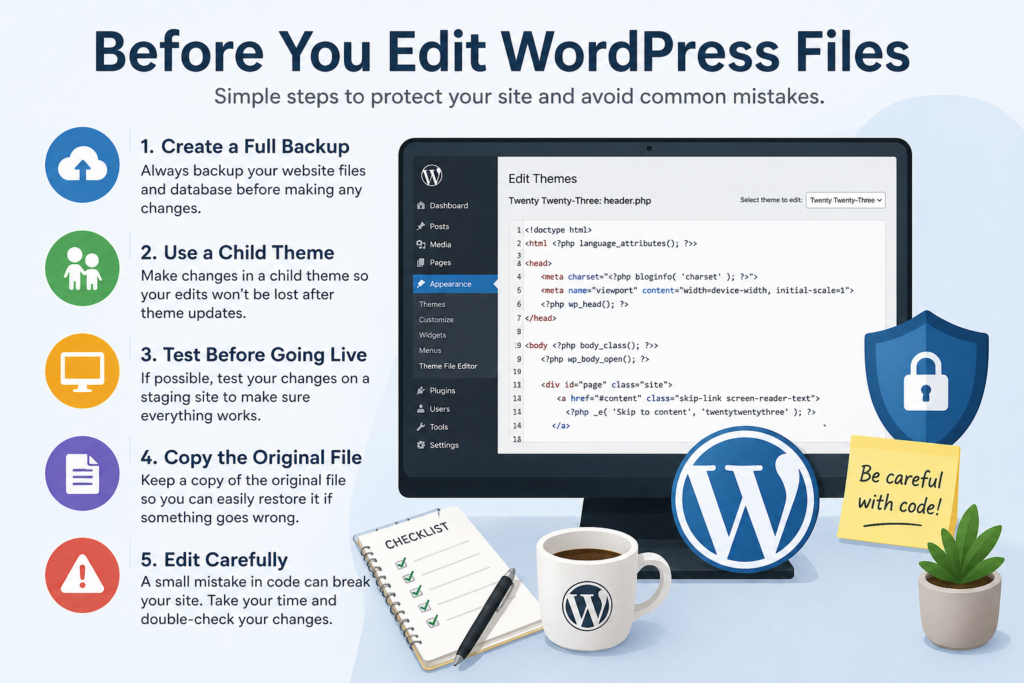
Before adding code, follow a few safety steps.
Create a full backup of your website. You should be able to restore your site if something goes wrong. Many hosting dashboards include backup tools. You can also download your files and export your database.
Use a child theme when possible. If you edit the main theme directly, your changes may disappear when the theme updates. A child theme keeps custom changes separate from the parent theme.
Avoid editing a live site without testing. If your hosting provider offers a staging site, test the code there first.
Copy the original file before editing. If you change 헤더.php 또는 functions.php, save a clean copy first.
Use only relevant keywords. Do not add long lists of random phrases. Keyword stuffing does not help and may make your code look spammy.
Once you understand these basics, you can choose one of the following methods.
Method 1: Add Meta Keywords Through header.php
The simplest method is to place the meta keywords tag directly inside the 헤더.php file. This method usually adds the same keywords to every page that uses that header.
This is easy, but it is not ideal for large blogs because every post will share the same keywords. It works better for small websites where the same general topics apply across the site.
Step 1: Log In to WordPress
Go to your WordPress login page:
yourdomain.com/wp-adminEnter your username and password. After logging in, you will see the WordPress dashboard.
Step 2: Open the Theme File Editor
In the left menu, go to:
Appearance → Theme File EditorWordPress may show a warning because editing theme files can break your website if the code is incorrect. Read the warning carefully before continuing.
Step 3: Find header.php
On the right side of the Theme File Editor, look for:
헤더.phpClick it to open the file. This file usually contains the beginning of your website’s HTML structure, including the <head> 부분.
Step 4: Locate the Head Section
Search for:
<head>그만큼 <head> area contains metadata, stylesheet links, scripts, and other technical elements.
Step 5: Add the Meta Keywords Tag
Place your meta keywords tag before the closing </head> tag:
<meta name="keywords" content="wordpress seo, meta keywords, wordpress website guide">Replace the example keywords with phrases that match your website.
For a blog about beginner WordPress tutorials, you might use:
<meta name="keywords" content="wordpress tutorials, beginner wordpress guide, wordpress seo basics">For a small business website, you might use:
<meta name="keywords" content="local business website, service website, company wordpress site">Step 6: Save and Test
Click Update File.
Then open your website in a browser. Right-click on the page and choose View Page Source. Use Ctrl + F 또는 Command + F and search for:
keywordsIf you see your meta keywords tag in the source code, the method worked.
Method 2: Add Meta Keywords Through functions.php
The second method uses the functions.php file. Instead of editing the header template directly, you create a small function that prints the meta keywords tag into the <head> area.
This method uses the WordPress wp_head hook. WordPress runs this hook inside the head section of most themes, so it is a common place to add custom meta tags.
Step 1: Open functions.php
Go to:
Appearance → Theme File EditorThen open:
functions.phpBe extra careful with this file. A PHP syntax error can affect your website.
Step 2: Add the Function
Scroll to the bottom of the file and add:
function custom_add_meta_keywords() {
    echo '<meta name="keywords" content="wordpress seo, meta keywords, wordpress tutorial">' . "\n";
}
add_action('wp_head', 'custom_add_meta_keywords');
This function tells WordPress to output the meta keywords tag in the head section.
Step 3: Change the Keywords
Edit the keyword list to match your website. For example:
function custom_add_meta_keywords() {
    echo '<meta name="keywords" content="wordpress guide, website seo, blogging tips">' . "\n";
}
add_action('wp_head', 'custom_add_meta_keywords');
Keep the keywords short and relevant. A good range is around three to six keyword phrases.
Step 4: Save and Check the Source Code
Click Update File.
Visit your site, right-click, and select View Page Source. Search for:
meta name="keywords"If the tag appears, the function is working.
This method is cleaner than directly editing 헤더.php, but it still adds the same keywords across the site unless you add more advanced conditional logic.
Method 3: Add Different Meta Keywords With Custom Fields
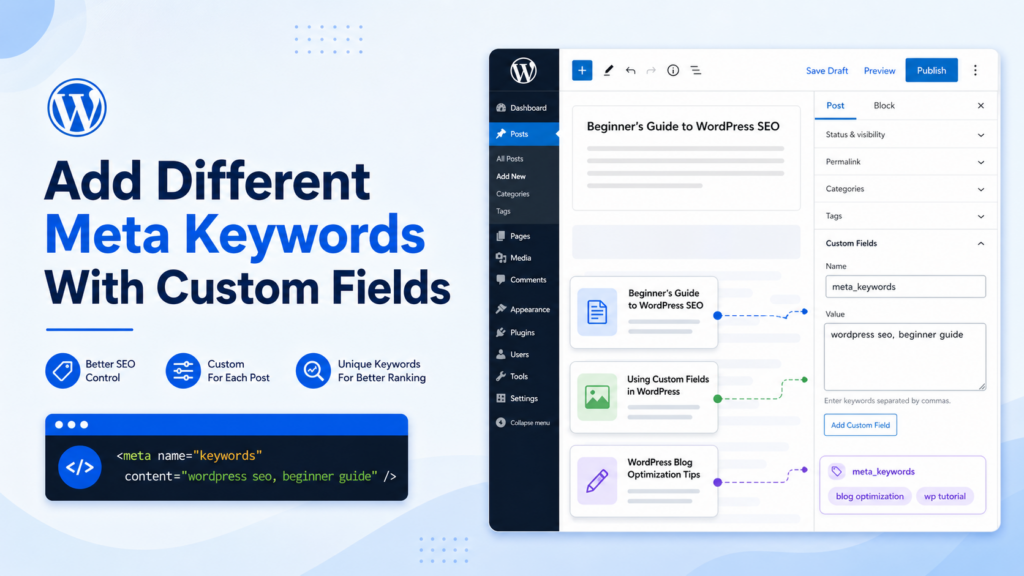
If your website has many blog posts or pages, using the same keywords everywhere is not useful. A post about speed optimization should not have the same keywords as a post about contact forms.
Custom fields solve this problem. They let you enter different meta keywords for individual posts or pages.
Step 1: Enable Custom Fields
Open a post or page in the WordPress editor.
If you use the block editor, click the three-dot menu in the upper-right corner, then go to Preferences. Look for Panels and enable Custom Fields if available. WordPress may ask you to reload the editor.
In some setups, custom fields may already be visible below the editor.
Step 2: Create a Custom Field
In the Custom Fields section, click Add New.
For the field name, enter:
meta_keywordsFor the value, enter your keywords:
wordpress seo tips, meta keywords guide, beginner seo tutorialClick Add Custom Field or update the post.
Step 3: Output the Field in the Head Section
Now WordPress needs code that reads the custom field and prints it as a meta tag. You can add this to functions.php:
function custom_post_meta_keywords() {
    if (is_singular()) {
        $keywords = get_post_meta(get_the_ID(), 'meta_keywords', true);

        if (!empty($keywords)) {
            echo '<meta name="keywords" content="' . esc_attr($keywords) . '">' . "\n";
        }
    }
}
add_action('wp_head', 'custom_post_meta_keywords');
This code checks whether the current page is a single post or page. Then it looks for the meta_keywords custom field. If the field exists, WordPress prints the keywords in the page source.
그만큼 esc_attr() function helps safely output the keyword value inside an HTML attribute.
Step 4: Test One Post
Open the post where you added the custom field. View the page source and search for:
keywordsYou should see the keywords you entered for that specific post.
This method gives you more control than adding one site-wide keyword tag. It is better for blogs, tutorials, and websites with many different content topics.
Which Method Should You Choose?
Choose the 헤더.php method if you only need one simple keyword tag across a small website.
Choose the functions.php method if you want a cleaner way to insert a site-wide tag without placing the code directly inside the header template.
Choose the custom fields method if you want different keywords for different posts or pages.
For most content websites, the custom fields method makes the most sense because each page usually targets a unique topic. However, it requires a little more setup.
흔히 저지르는 실수들을 피하는 방법
The first mistake is expecting meta keywords to improve Google rankings. They will not. Google has said it does not use the keywords meta tag for web ranking.
The second mistake is adding too many keywords. A long list of keywords looks messy and may create a spam-like signal. Keep the list focused.
The third mistake is using unrelated keywords. If a page is about WordPress SEO, do not add keywords about hosting, design, eCommerce, and social media unless the page actually covers those topics.
The fourth mistake is editing theme files without a backup. Always protect your site before changing code.
The fifth mistake is creating duplicate meta keywords tags. If your theme or another tool already outputs a keywords tag, adding another one can create duplicate metadata.
The sixth mistake is forgetting theme updates. If you edit a parent theme directly, your changes may disappear later.
Best Practices for Meta Keywords
Use only keywords that match the page content.
Keep the keyword list short.
Use comma-separated phrases.
Avoid repeating the same word too many times.
Do not use competitor brand names.
Do not treat meta keywords as your main SEO strategy.
Review your page source after adding the code.
Update keywords when the page content changes.
Spend more time improving titles, headings, content quality, internal links, and user experience.
A clean meta keywords tag is acceptable, but a useful page is far more important.
Better SEO Elements to Focus On
If your goal is better search visibility, focus first on the elements that actually affect how users and search engines understand your content.
Your page title should clearly describe the topic. It should include the main keyword naturally and encourage clicks.
Your meta description should summarize the page in a helpful way. It may not directly control rankings, but it can influence whether people click your result.
Your headings should organize the article clearly. Use H2 and H3 headings to guide readers through the page.
Your content should answer the search query completely. For the keyword how to add meta keywords in wordpress without plugin, readers expect a simple explanation, safe code examples, and clear testing steps.
Your internal links should connect related pages. For example, a WordPress SEO article can link to guides about title tags, meta descriptions, speed optimization, and content structure.
Your website should load quickly and work well on mobile devices. Technical SEO and user experience often matter more than old metadata fields.
결론
Learning how to add meta keywords in 워드프레스 without plugin helps you understand how WordPress handles metadata and how theme files control the HTML structure of your site. You can add meta keywords by editing 헤더.php, using a function in functions.php, or creating custom fields for individual posts and pages.
그만큼 헤더.php method is simple but usually adds the same keywords everywhere. The functions.php method is cleaner for site-wide output. The custom fields method gives you better control because each post or page can have its own keyword list.
Meta keywords are no longer an important Google ranking factor, so they should not be the center of your SEO strategy. Use them carefully, keep them relevant, and avoid keyword stuffing. More importantly, focus on strong titles, useful content, clear headings, internal links, fast loading speed, and a better user experience.
자주 묻는 질문
1. Can I add meta keywords in WordPress without a plugin?
Yes. You can add meta keywords manually by editing your theme’s 헤더.php file, adding code to functions.php, or using custom fields for individual posts and pages.
2. Do meta keywords still help with Google SEO?
Meta keywords are no longer an important Google ranking factor. They can still be used for learning, internal organization, or older systems, but they should not be your main SEO strategy.
3. Where should I place the meta keywords tag in WordPress?
The meta keywords tag should be placed inside the <head> section of your WordPress website, usually before the closing </head> tag.
4. Is it safe to edit WordPress theme files?
It can be safe if you back up your website first, use a child theme, and edit carefully. A small code mistake in theme files may cause display or functionality issues.
5. Can I add different meta keywords for each WordPress post?
Yes. You can use WordPress custom fields to add unique meta keywords for each post or page, then output those custom field values in the page head section.
6. What should I focus on instead of meta keywords?
Focus on clear SEO titles, useful meta descriptions, high-quality content, proper headings, internal links, fast loading speed, and a mobile-friendly website experience.


완전한 전자상거래 시스템을 갖춘 워드프레스 웹사이트 또는 기업 사이트를 디자인하고 구축하세요.
가격 범위: $200.00~$2,500.00custom-requirements-or-special-quotations
원래 가격: $2.00.$1.00현재 가격: $1.00. 워드프레스 전자상거래 쇼핑몰에 플러그인 50개는 너무 많은 걸까요?
실제 성능에 미치는 영향 이해하기 워드프레스 전자상거래 사이트에 50개의 플러그인이 있다고 해서 자동으로 문제가 되는 것은 아닙니다. 사실 그 숫자만으로 성능이 결정되는 경우는 거의 없습니다....

아마존 가정용 물리치료 기기 메인 이미지 디자인 설명
소개 소개: 아마존에서 홈 테라피 기기의 신뢰할 수 있는 이미지 구축 아마존에서 홈 테라피 기기의 기본 이미지를 디자인할 때 기본 ...

아마존 립스틱 전환을 위한 메인 이미지 디자인
소개: 소개: 아마존에서 판매되는 립스틱 메인 이미지 디자인하기 아마존 립스틱의 메인 이미지를 디자인할 때 우리의 책임은 그 이상입니다.

해커들이 워드프레스 관리자 이메일을 훔치는 방법(그리고 이를 막는 방법)
불편한 진실부터 말씀드리자면, 워드프레스 관리자 이메일은 생각보다 훨씬 더 많이 공개되어 있습니다. 그들은 그것을 좋아합니다. 해커에게 여러분의...

아마존 리퀴드 파운데이션 메인 이미지 변환의 특징은 무엇일까요?
서론 아마존 리퀴드 파운데이션의 메인 이미지 디자인은 단순히 제품을 아름답게 보이게 하는 것만이 아닙니다. 아마존에서 메인 이미지와...

필터 카트리지 제품을 위한 효과적인 아마존 메인 이미지 디자인하기
서론 아마존 메인 이미지 디자인은 단순히 제품을 매력적으로 보이게 하는 것만이 아닙니다. 명확성, 신뢰, 그리고 즉각적인 이해를 제공하는 것이 중요합니다. 특히...

워드프레스에 대한 리플레이 공격: 실제 위협인가, 과장된 신화인가?
먼저 한 가지를 분명히 해두죠. 리플레이 공격은 겉보기에 무섭지 않습니다. 비밀번호를 날려버리지도 않고, 초록색 해커 텍스트가 사방에 흩날리는 악성 코드를 주입하지도 않습니다. 그저 교묘하게 이루어질 뿐입니다.
WordPress 페이지를 손상 없이 복제하는 방법
솔직히 말해봅시다. 때로는 새 페이지를 만들고 싶지 않을 때가 있죠. 그냥 기존 페이지를 약간만 다르게 하고 싶을 때가 있어요. 레이아웃도, 블록도, 설정도 그대로요. 왜냐하면...

반려동물 관련 워드프레스 테마 5가지 비교
서론 반려동물 관련 워드프레스 테마를 선택하는 것은 단순한 디자인 결정 이상의 의미를 지닙니다. 사용성, 확장성, 그리고 장기적인 비즈니스 성장에 직접적인 영향을 미치기 때문입니다. 반려동물 관리 및 관련...

수영복 온라인 쇼핑몰 테마 5가지 비교
서론 수영복이나 란제리 독립 매장에 적합한 테마를 선택하는 것은 단순히 시각적인 결정에 그치는 것이 아니라, 전환율, 확장성, 그리고 장기적인 성공에 직접적인 영향을 미칩니다.

워드프레스에서 댓글 기능을 끄는 방법 (정신줄 놓지 않고)
워드프레스 댓글에 대해 이야기해 봅시다. 이론적으로 댓글은 훌륭합니다. 토론을 장려하고, 커뮤니티를 형성하며, 웹사이트에 생동감을 불어넣습니다. 하지만 현실은 어떨까요? 댓글은 종종 문제를 야기하기도 합니다...

워드프레스 500 오류: 웹사이트가 갑자기 오류를 일으킬 때
방금 전까지만 해도 워드프레스 사이트는 아무 문제 없었는데, 페이지를 새로고침하자마자 갑자기 💥 500 내부 서버 오류가 발생했습니다. 아무런 설명도, 사과도 없이 그저 차갑고 혼란스러운 메시지만 남았습니다.

과학 중심 브랜드를 위한 확장 가능한 워드프레스 웹사이트 구축: 아미노USA 프로젝트
서론 오늘날의 디지털 환경에서 웹사이트는 단순히 제품을 나열하는 공간 이상의 의미를 지닙니다. 규제 산업이나 연구 중심 산업에서 활동하는 과학 기반 브랜드에게 웹사이트는 더욱 중요한 역할을 합니다.

글로벌 블레이드 브랜드를 위한 확장 가능한 쇼피파이 스토어 구축: 쿨카타나 프로젝트
서론: 국경을 넘나드는 전자상거래에서 Shopify 웹사이트는 단순한 매장 이상의 의미를 지닙니다. 특정 문화권에서 사업을 운영하는 브랜드의 경우, 웹사이트는 단순한 판매 공간을 넘어 훨씬 더 많은 기능을 수행해야 합니다.

포켓몬 카드 판매를 위한 높은 전환율을 자랑하는 쇼피파이 스토어 디자인하기
서론 수집품 전자상거래, 특히 포켓몬 트레이딩 카드 게임(TCG) 시장에서 웹사이트는 단순히 제품 목록을 나열하는 것 이상의 역할을 해야 합니다.
맞춤형 오프라인 브랜드에 최적화된 전환율 높은 쇼피파이 디자인
서론 오늘날 경쟁이 치열한 전자상거래 환경, 특히 맞춤형 선물 및 수집품 분야에서 Shopify 웹사이트는 단순히 제품을 전시하는 것 이상의 역할을 해야 합니다. ...

Shopify 고객 지원팀에 문의하는 방법: 간단하고 스트레스 없는 가이드
쇼피파이 스토어 운영은 흥미진진해야지 혼란스러워서는 안 됩니다. 궁금한 점이 생기거나 문제가 발생하여 진행이 늦어질 때, 쇼피파이는 상황에 따라 다양한 지원 경로를 제공합니다.
쇼피파이 스토어 비활성화 방법: 명확하고 실용적인 가이드
쇼피파이 스토어를 비활성화하는 것은 복잡하지 않지만, 많은 판매자가 간과하는 몇 가지 결과가 따릅니다. 이 가이드에서는 비활성화 과정을 간단하고 유익하게 설명합니다.