소개
When building a website for business, two questions always come up: Is it fast? And can I rely on it? These concerns are even more important when choosing between platforms like 워드프레스 and newer tools such as HighLevel (also known as GoHighLevel).
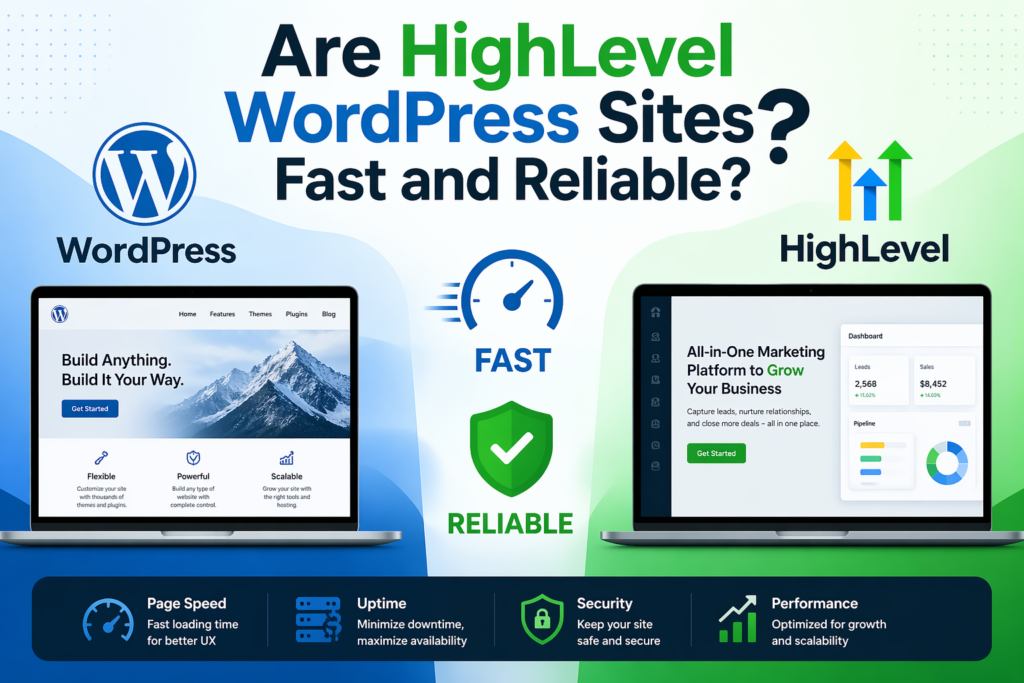
If you’ve ever wondered, “are highlevel wordpress sites fast and reliable?”—this guide breaks it down in a clear, practical, and easy-to-understand way. Instead of diving into technical jargon, we’ll explore how these platforms perform in real-world scenarios, what affects speed and reliability, and how you can make the best choice for your needs.
Understanding Website Speed and Reliability

Before comparing platforms, it’s important to define what “fast” and “reliable” actually mean.
What Is Website Speed?
Website speed refers to how quickly your pages load when a user visits your site. This includes:
- Initial page load time
- Time to interactive (when users can click or scroll)
- Image and media loading performance
Speed directly affects user experience. Studies show that if a website takes more than a few seconds to load, visitors are likely to leave.
What Is Website Reliability?
Reliability is about consistency. A reliable website:
- Stays online without downtime
- Handles traffic spikes without crashing
- Delivers consistent performance across devices
For businesses, reliability is critical—especially for eCommerce, lead generation, and content-driven sites.
What Is HighLevel and How Does It Work?

HighLevel (GoHighLevel) is an all-in-one marketing platform. It combines:
- Website and funnel building
- CRM (Customer Relationship Management)
- Email and SMS automation
- Sales pipelines
Unlike WordPress, which is open-source and flexible, HighLevel is a closed, hosted system. That means everything—from hosting to updates—is managed within its ecosystem.
What Is WordPress and Why Is It Popular?

WordPress is the world’s most widely used website platform. It powers millions of sites, from blogs to large business websites.
Key characteristics of WordPress:
- Open-source and highly customizable
- Works with thousands of themes and plugins
- Can be hosted anywhere (shared hosting, VPS, cloud servers)
Because of this flexibility, WordPress can be incredibly powerful—but also depends heavily on how it’s set up.
Are HighLevel WordPress Sites Fast?
Let’s get to the core question: are highlevel wordpress sites fast?
HighLevel Speed Performance
HighLevel is designed for simplicity and convenience. Since it’s a hosted platform:
- Servers are managed for you
- Optimization is handled internally
- No need to configure caching or CDN manually
장점:
- Consistent performance out of the box
- No technical setup required
- Suitable for funnels and landing pages
제한 사항:
- Less control over performance optimization
- Page builders may produce heavier code
- Limited flexibility for advanced speed tuning
In general, HighLevel sites are moderately fast, especially for simple pages and funnels. However, they may not match the speed of a highly optimized WordPress site.
WordPress Speed Performance
WordPress speed varies widely depending on setup.
A poorly configured WordPress site can be slow, but a well-optimized one can be extremely fast.
Factors affecting WordPress speed:
- 호스팅 품질
- Theme design (lightweight vs. bloated)
- Number of plugins
- 이미지 최적화
- Use of caching and CDN
장점:
- Can achieve extremely fast load times
- Full control over optimization
- Scalable for high-traffic sites
제한 사항:
- Requires setup and maintenance
- Performance depends on user decisions
- Misconfiguration can slow things down
Conclusion on speed:
- HighLevel = consistent but limited
- WordPress = variable but potentially much faster
Are HighLevel WordPress Sites Reliable?
Now let’s look at reliability.
HighLevel Reliability
Because HighLevel is a hosted platform:
- Server maintenance is handled for you
- Updates are automatic
- Infrastructure is centralized
Advantages:
- Minimal downtime risk for users
- No need to manage hosting
- Stable environment for non-technical users
Drawbacks:
- You depend entirely on the platform
- Limited control if issues arise
- Outages affect all users simultaneously
Overall, HighLevel is reliable for small to medium use cases, especially for marketing funnels.
WordPress Reliability
WordPress reliability depends on your hosting and setup.
With poor hosting:
- Frequent downtime
- Slow response times
- Security vulnerabilities
With high-quality hosting and optimization:
- Extremely stable performance
- High uptime (99.9% or better)
- Ability to handle large traffic volumes
Advantages:
- Full control over hosting environment
- Ability to scale with your business
- More resilient with proper configuration
Challenges:
- Requires monitoring and maintenance
- Security updates must be managed
- Plugin conflicts can cause issues
Conclusion on reliability:
- HighLevel = simple and stable
- WordPress = powerful but depends on setup
Key Factors That Affect Speed and Reliability
Regardless of platform, several factors influence performance.
1. Hosting Infrastructure
- HighLevel: Managed hosting
- WordPress: User chooses hosting
Better hosting = faster and more reliable performance.
2. Design Complexity
Heavy designs slow down any platform.
- Large images
- Animations
- Complex layouts
Keeping design clean and minimal improves speed.
3. Optimization Techniques
WordPress allows advanced optimization:
- Caching plugins
- CDN integration
- Image compression
- Lazy loading
HighLevel offers fewer customization options in this area.
4. Traffic Volume
High traffic can stress any system.
- HighLevel handles moderate traffic well
- WordPress can scale with proper infrastructure
5. Maintenance and Updates
- HighLevel: automatic updates
- WordPress: manual or semi-automated
Regular updates improve reliability and security.
Real-World Use Cases
When HighLevel Works Best
HighLevel is ideal for:
- Marketing funnels
- 리드 생성 페이지
- Small business websites
- Agencies managing multiple clients
It’s designed for convenience rather than deep customization.
When WordPress Works Best
WordPress is better suited for:
- 콘텐츠가 풍부한 웹사이트
- Blogs and SEO-focused sites
- eCommerce stores
- Custom-designed websites
It offers unmatched flexibility and scalability.
Speed vs Convenience: The Trade-Off
The main difference comes down to control.
HighLevel
- Easier to use
- Less technical work
- Limited optimization
워드프레스
- 더 복잡한
- Highly customizable
- Can achieve superior performance
This trade-off is important when deciding which platform to use.
Common Misconceptions
“HighLevel is always faster”
Not necessarily. While it’s optimized by default, it lacks the advanced tuning options available in WordPress.
“WordPress is slow”
WordPress is only slow when poorly configured. With proper optimization, it can outperform many platforms.
“Reliability depends only on the platform”
In reality, reliability depends on:
- 호스팅 품질
- Site structure
- Maintenance practices
How to Make Any Website Faster and More Reliable
No matter which platform you choose, these best practices apply.
Optimize Images
- Use compressed formats
- Avoid oversized files
Keep Design Clean
- Reduce unnecessary elements
- Limit animations
Use Fast Hosting
- Choose reliable providers
- Avoid cheap shared hosting
Minimize Third-Party Scripts
Too many external scripts can slow down your site.
Regular Maintenance
- Update plugins and themes
- Monitor performance
- Fix errors promptly
Final Verdict: Are HighLevel WordPress Sites Fast and Reliable?
So, are highlevel wordpress sites fast and reliable?
The answer depends on how you define “fast” and “reliable.”
- HighLevel offers consistent speed and reliability with minimal effort, making it a great choice for users who prioritize simplicity.
- 워드프레스 provides greater potential for speed and reliability, but only when properly optimized and maintained.
요약하자면:
- If you want ease of use → HighLevel is a solid option
- If you want maximum performance and flexibility → WordPress is the better choice
결론
Website speed and reliability are not determined by platform alone—they depend on how the platform is used.
HighLevel simplifies the process by handling everything for you, making it reliable and easy to manage. 워드프레스, on the other hand, gives you full control, allowing for higher performance but requiring more effort.
Understanding these differences helps you choose the right solution based on your goals, technical skills, and long-term needs.
자주 묻는 질문
HighLevel websites are generally fast out of the box due to managed hosting, but WordPress sites can be faster when properly optimized with caching, CDN, and high-performance hosting.
HighLevel offers stable reliability with minimal setup, while WordPress reliability depends on hosting quality and maintenance. A well-managed WordPress site can be just as reliable or even more scalable.
WordPress sites can be slow due to poor hosting, heavy themes, too many plugins, unoptimized images, or lack of caching and performance optimization.
Yes, WordPress can outperform HighLevel in speed if it is properly optimized with lightweight themes, fast hosting, and performance tools.
HighLevel is easier for beginners because it handles hosting and maintenance automatically, while WordPress requires more setup but offers greater flexibility.
Key factors include hosting quality, site design complexity, image optimization, traffic load, and ongoing maintenance—regardless of the platform used.