How much will it cost to build a cross-border ecommerce brand website in 2026? Don’t ask the service provider to quote an “industry uniform price” first. Also called brand website, some projects only need to be able to display products and receive customer inquiries, while others require multi-language, multi-currency, online payment, order synchronization and continuous operation. A truly comparable budget should separate the initial build, annual renewals, transaction-related costs and subsequent content maintenance, and then use the same demand list for inquiry. This article gives you a set of disassembly methods that can be used directly without pretending that the sample requirements are the average market price.
First confirm what kind of website you want to build
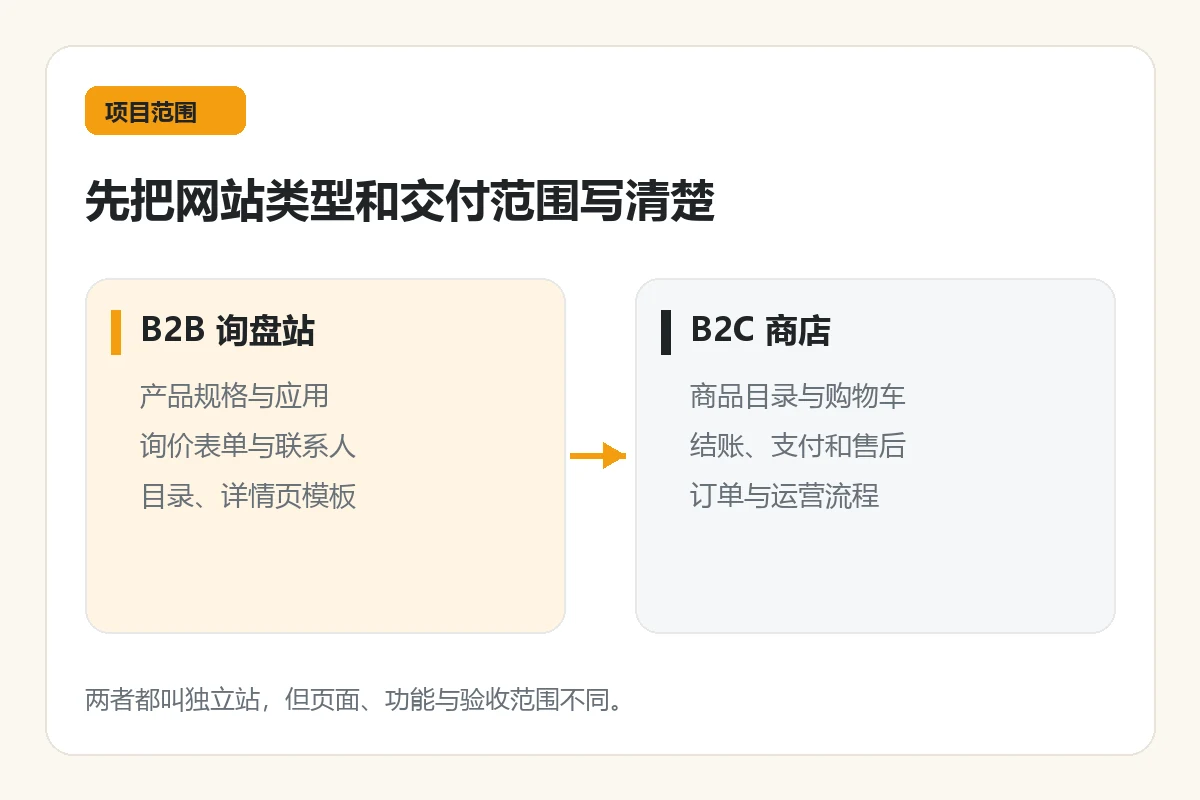
The first step is not to choose a platform, but to write down the main business actions. B2B foreign trade stations often hope that buyers can find product specifications, application scenarios and submit inquiries; B2C stores also need shopping cart, checkout, payment and after-sales information. Both are called brand websites, but the page template, content, system docking and testing scope are different. If the quotation only states “a set of brand website” but does not explain how many types of pages and what business actions are to be done, it will be almost impossible to judge whether subsequent additions are reasonable.
Start by listing your target market and languages, the number of products, whether you have ready-made branding materials, how many page templates you need, and who will be responsible for uploading the content. Having many products does not necessarily mean that each product must be designed individually; the key is whether the directory structure, filtering rules, and product detail templates need to be differentiated. Conversely, a customized customer inquiry station with a small number of pages may also increase the workload due to data collection, drawing uploading, or multi-role approval.
What fees do quotations usually consist of?
One-time construction fee
The planning phase determines the audience, navigation, page hierarchy, and conversion paths. The design phase includes visual direction, homepage and key templates, mobile adaptation and revision rounds. The development phase turns the design into a manageable website and completes forms, products, payments or other agreed functions. The content stage may include copywriting, translation, product image processing and data entry. Testing and launch should also specify the browser, mobile phone, form, order and jump check. Each link has a person in charge and acceptance items. You cannot judge the completion of the project based on just a home page rendering.
Ongoing usage fees
Domain names, platform subscriptions or hosting, premium themes, plugins or apps, email services, backups, security and technical maintenance often continue to occur after go-live. If online transactions are involved, you need to check the applicable regions, settlement conditions and possible transaction fees of the payment service provider separately. Shopify official pricing page Display packages and billing standards; WooCommerce official fee description Then separate the core software from the host, expansion and other costs. Both pages are self-described by the service provider. Prices, regions and promotions will change. The actual terms in the account shall prevail during formal purchase.

Compare three website development methods on the same scale
The table below compares cost liability and scope of work, not “which is necessarily cheaper.” Building it yourself, using a SaaS platform, or entrusting a service provider may all meet your needs; the difference lies in where you put your time, technology, and long-term maintenance responsibilities. For the functional trade-offs between Shopify and WordPress, you can read further Comparison of WordPress and Shopify foreign trade website development 。
| Compare dimensions | Build it yourself | SaaS platform plus self-configuration | Commissioned customized services |
|---|---|---|---|
| main expenses | Domain name, host/software, materials and team time | Subscriptions, topics, apps and team time | Plan and production fees, plus platform and ongoing costs |
| who is responsible for implementation | Enterprise team | Enterprise team and platform provide basic capabilities | Assigned to service providers and enterprises according to contracts |
| Ongoing maintenance | Need to build your own process or purchase additional services | The platform and the enterprise are each responsible for their own scope | It must be clearly stated in the contract separately |
| Applicable conditions | Is there someone internally who can manage it for the long term? | Businesses can be carried by ready-made platforms | Requires special planning, design or system docking |
This table is a project decision-making framework, not an official item-by-item comparison of platform functionality. Platform subscription and expansion boundaries can be found on the official page above; the service provider’s quotation must be combined with the specific contract. In particular, confirm whether the quotation includes platform fees to avoid misinterpreting “low production fee” as “low total cost of ownership”.
How to calculate the accounts for the first and second years without missing items?
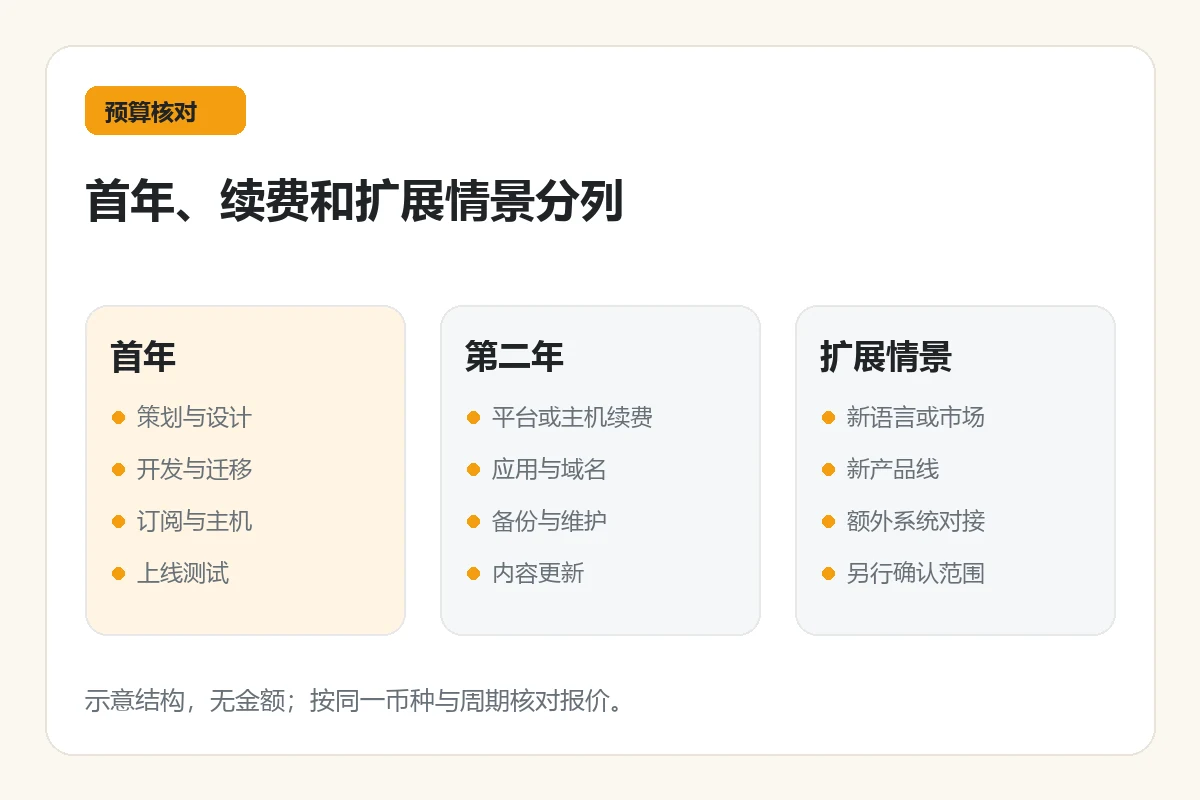
It is recommended to create a two-column budget: the total expenses for the first year, and the expenses required to maintain the same functions in the second year. In the first year, one-time planning, design, development, migration and training are included, as well as periodic charging items such as domain names, platforms, applications, etc.; in the second year, renewals, updates, backups, content maintenance and possible service support are continued. If you plan to add languages, markets, or product lines, add a column called “Expansion Scenarios.” Do not factor future expansion assumptions into your current commitments.
Ask about the payment cycle, currency, tax and exchange rate bearer, normal price after the promotion ends, third-party service account ownership, and how the data can be exported after the service is deactivated. Figures for different periods and currencies cannot be directly compared together. Expressions such as “free forever” and “one-time payment” should also ask about the actual resources and maintenance scope covered. When choosing self-hosted WordPress, you can also refer to Foreign Trade WordPress Host Selection Guide 。
Before inquiring from service providers, prepare these 12 requirements
A clear enough inquiry card can be written in the following 12 items: ① Target country and language; ② B2B customer inquiry or B2C transaction; ③ Estimated product or SKU quantity; ④ Template types such as homepage, list, details, content page, etc.; ⑤ Product filtering and site search requirements; ⑥ Payment, freight or customer inquiry data field; ⑦ Existing website migration scope; ⑧ Who provides copywriting, translation, photos and videos; ⑨ Delivery list of SEO basic settings; ⑩ Third-party system or CRM docking; ⑪ Training, account permissions and handover; ⑫ Online acceptance, modification rounds and maintenance period. It is more useful to write “to be confirmed” for uncertain items than to let the service provider guess by default.
For example, if it is also a product display site, if Party A provides complete English copywriting and pictures, the scope of content production in the quotation can be smaller; if it is necessary to organize specifications, shoot, translate and enter multiple language versions from scratch, these tasks should be listed separately. This example only illustrates how the scope of work changes and does not represent the actual project amount. Please ask each service provider to fill in “included, optional, not included” on the same card, and write the acceptance method into the quotation attachment.
What should you focus on after receiving a quote?
First check the page template and function list, and then look at the deliverables: whether an editable backend, design source files or components, necessary operating instructions, test records and account handover are provided. Then look at the change mechanism: how to charge for new pages, functional changes, and repeated content modifications. Finally, look at the responsibilities after going online: who is responsible for fault response, version updates, backup and recovery, and whether there are clear service times and boundaries. Two quotations with similar prices but different scope of delivery cannot be compared based only on the total amount.
If you’re undecided on Shopify or WordPress, you don’t have to lock yourself into a platform before asking your provider to “do it.” First explain the business path clearly, and then let the plan explain why the platform is suitable, what are the limitations, and what problems will be encountered in future migration. This comparison is about actual demand matching, not sales rhetoric.

Conclusion: Determine the scope first, then compare prices
The international business website does not have a reliable unified price that is independent of demand. First, clarify who the website will serve, what actions it will complete, and which pages and systems are needed; then list the one-time costs and ongoing costs separately, and inquire with different service providers based on the same scope. A low price that does not list content, maintenance, account ownership and acceptance methods is not yet a comparable complete quote. If you already have product information and target markets, you can sort out the 12 requirements above and check Shopify e-commerce website building services , or consult AIRSANG for a website development plan split by scope; the specific cost should be based on the written quotation after confirmation of demand.