










لا توجد منتجات في سلة التسوق.

Customer expectations in ecommerce have changed quickly. Shoppers do not want to wait hours for answers about shipping, product availability, returns, sizing, discounts, or order changes. At the same time, growing stores cannot always solve the problem simply by hiring more support agents.
This is why AI-powered customer service tools for Shopify و ووكومرس are becoming important. Modern systems can do more than display scripted chatbot replies. They can use store content, product information, policies, and sometimes customer or order data to answer questions, recommend products, summarize conversations, route tickets, and hand difficult cases to a human agent.
The key question is no longer, “Do we need a chatbot?” A better question is, “Which customer-service tasks should AI handle, and which should remain human?”
This guide explains how AI customer support works, which capabilities matter most, how Shopify and WooCommerce differ, and how merchants can evaluate popular tools without relying only on marketing claims.
Traditional ecommerce chatbots usually follow fixed rules. If a shopper asks a question that matches a predefined keyword or menu option, the bot returns a stored answer. This can work for simple FAQs, but it often fails when customers use unexpected wording or ask several questions at once.
AI-powered customer service tools are more flexible. They can use approved store information as context and generate responses that fit the shopper’s question.
Depending on the platform and permissions, an AI assistant may:
The key difference is context. A useful ecommerce AI assistant should understand the store it represents, not just general information.
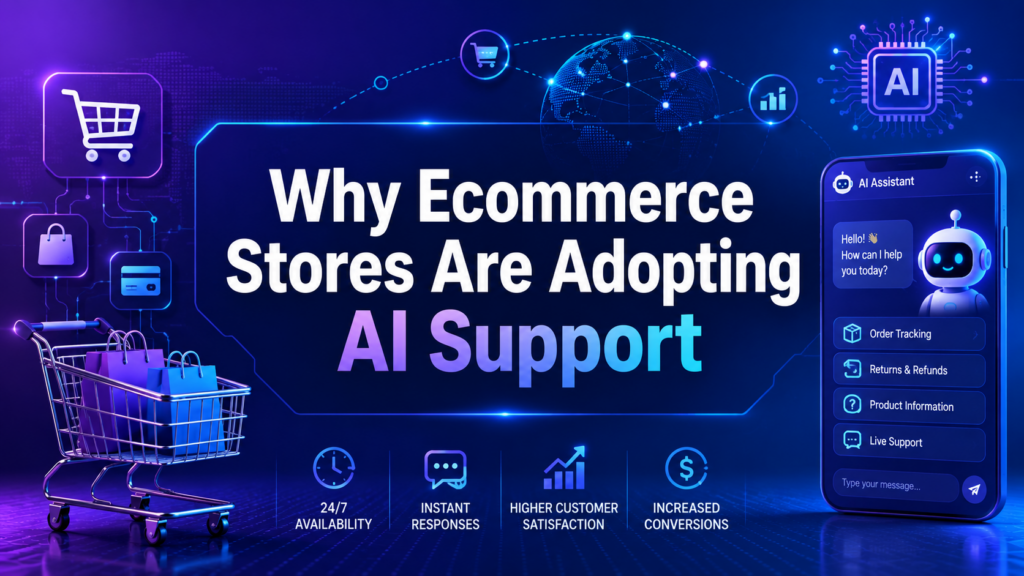
Much of ecommerce support is repetitive. Customers often ask whether an item is in stock, when an order will arrive, how to return a product, which size to choose, or why a promotion did not apply. Modern AI systems become more valuable when they can move beyond simple FAQs and work with store or order information.
Automation can help in several ways. Customers can receive assistance outside normal business hours, human agents can spend more time on complex cases, and standardized knowledge can reduce inconsistent answers. Some AI systems can also support sales by helping shoppers discover the right product before they leave the site.
Still, AI should not be treated as a complete replacement for people. Refund disputes, damaged orders, policy exceptions, frustrated customers, and unusual account issues often require human judgment.
The strongest setup is usually a hybrid model: AI handles predictable work while people handle ambiguity.
Shopify and WooCommerce both support AI customer service, but their ecosystems are different.
Shopify is a hosted commerce platform with a standardized app environment. This makes it easier for some customer-service tools to connect to product, inventory, order, and customer information. Shopify’s own Inbox product, for example, is built directly for Shopify stores and can use catalog, policy, and store content to assist shoppers.
WooCommerce is more modular because it runs on WordPress. Store owners can combine different hosts, themes, plugins, checkout systems, and extensions. That flexibility is valuable, but it also means merchants must pay more attention to compatibility, data access, updates, and maintenance.
WooCommerce also offers AI chatbot extensions that can be trained on store products and documents, and some can let logged-in shoppers ask about their own orders.
For this reason, the best AI-powered customer service tools for Shopify and WooCommerce are not always identical. Shopify merchants may prioritize deep native order integrations, while WooCommerce merchants may place more weight on plugin compatibility and flexibility.
Many tools now call themselves AI-powered. That label alone says little. Merchants should evaluate what the system can actually do.
An AI assistant needs reliable information. Look for tools that can learn from product pages, FAQs, policies, help-center content, and other approved sources.
More content is not always better. Old policies, duplicate pages, and conflicting product information can lead to poor answers. Good AI support begins with clean source material.
The assistant becomes more useful when it can understand real commerce data, such as product availability, variants, order status, tracking information, and fulfillment details.
Tidio, for example, documents dedicated integrations for both Shopify and WooCommerce, including product recommendations through its Lyro AI Agent.
There is a major difference between explaining how a return works and actually initiating a return workflow.
More advanced systems may support actions such as modifying an order, issuing a refund, canceling an order, or starting a return. These capabilities can save more time than FAQ automation, but they also require stronger permissions and safeguards.
Merchants should clearly define which actions AI may perform automatically and which require human approval.
No AI system should be expected to solve every case.
A good handoff should transfer the customer’s message, relevant store information, previous responses, and a short summary of the issue. Customers should not have to repeat everything after being transferred.
Customers may contact a store through website chat, email, Instagram, Facebook, SMS, or other channels. Growing teams often benefit from bringing those conversations into one workspace.
Re, for example, supports both Shopify and WooCommerce integrations, and its current product information says its AI can use product and order data from those platforms as support context.
AI should be measurable. Store owners should be able to review what customers ask, which conversations AI resolves, where escalation happens, and which answers receive poor feedback.
They should also be able to control tone, knowledge sources, permissions, and fallback rules. Without reporting, a merchant may know AI is active without knowing whether it is actually helping customers.
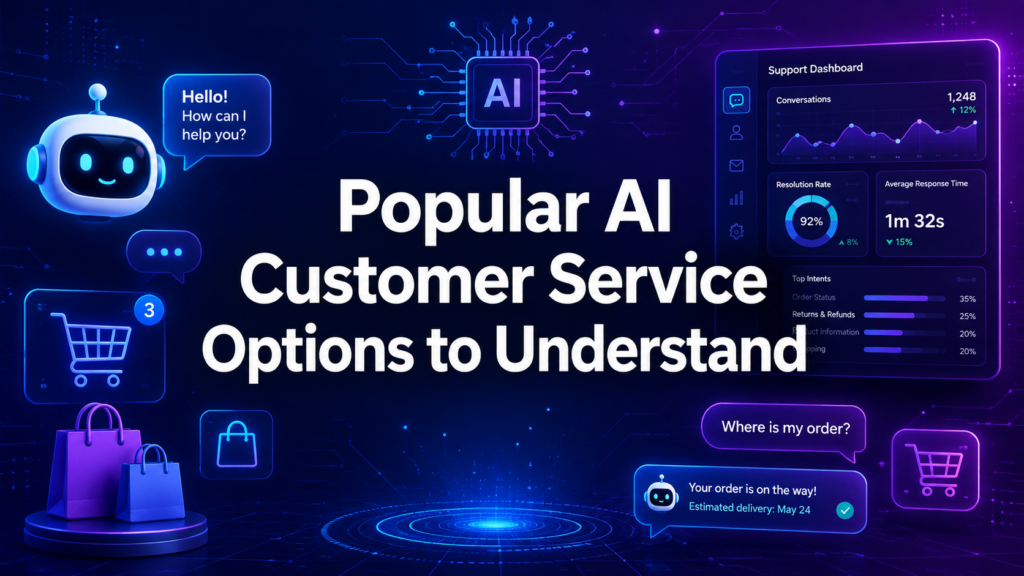
There is no universal winner. It is more useful to understand how different tools fit different store types.
Shopify Inbox is a natural starting point for merchants who want support chat inside the Shopify ecosystem.
Shopify describes it as a messaging tool for online-store conversations, and its current App Store listing highlights an AI sales-associate experience connected to catalog, inventory, policies, and store content.
Its main advantage is simplicity. The tradeoff is that larger teams with more channels, detailed routing, or advanced automation may eventually need a dedicated helpdesk.
It is also Shopify-specific, so it is not a cross-platform choice for WooCommerce.
Tidio is especially relevant because its Lyro AI Agent supports dedicated integrations for both Shopify and WooCommerce. Tidio also documents AI-assisted product recommendations for both ecosystems.
This makes it attractive to stores that want conversational AI, live chat, and product discovery without immediately adopting a heavyweight enterprise helpdesk.
The main question is whether its available order actions and workflow depth match the store’s real needs.
Gorgias is built around ecommerce customer service. Its Shopify integration can surface customer and order information inside the support workspace, while its WooCommerce integration connects commerce data for support use.
Gorgias becomes more relevant when support is turning into a structured operation rather than a simple chat function. Routing, automation, order context, and ecommerce workflows can be managed in one system.
The tradeoff is complexity. Stores should compare total cost, setup requirements, AI usage terms, and actual workflow needs instead of assuming more features automatically means a better fit.
Re combines customer conversations from different channels and integrates with both Shopify and WooCommerce.
It can place ecommerce information beside conversations, reducing the need for agents to switch repeatedly between a helpdesk and store admin.
This approach suits brands that already receive support from multiple channels and want a shared inbox plus automation.
Freshdesk is not limited to ecommerce, but its marketplace includes connections for Shopify and WooCommerce. Freshworks documents Shopify order information inside Freshdesk and lists WooCommerce connectors as well.
A broader helpdesk can make sense for companies that need formal ticket management, routing, reporting, or service processes across more than one business function.
Smaller stores, however, may find a general-purpose platform more complex than an ecommerce-focused tool.
WooCommerce merchants can also choose WordPress and WooCommerce extensions built specifically for AI chat.
Official WooCommerce marketplace documentation shows tools that can train assistants on store products or uploaded knowledge and, in some cases, let shoppers retrieve order information.
These extensions can be appealing when a merchant wants AI directly inside WordPress.
Before installing one, however, store owners should review update history, compatibility, data handling, performance, and support quality.
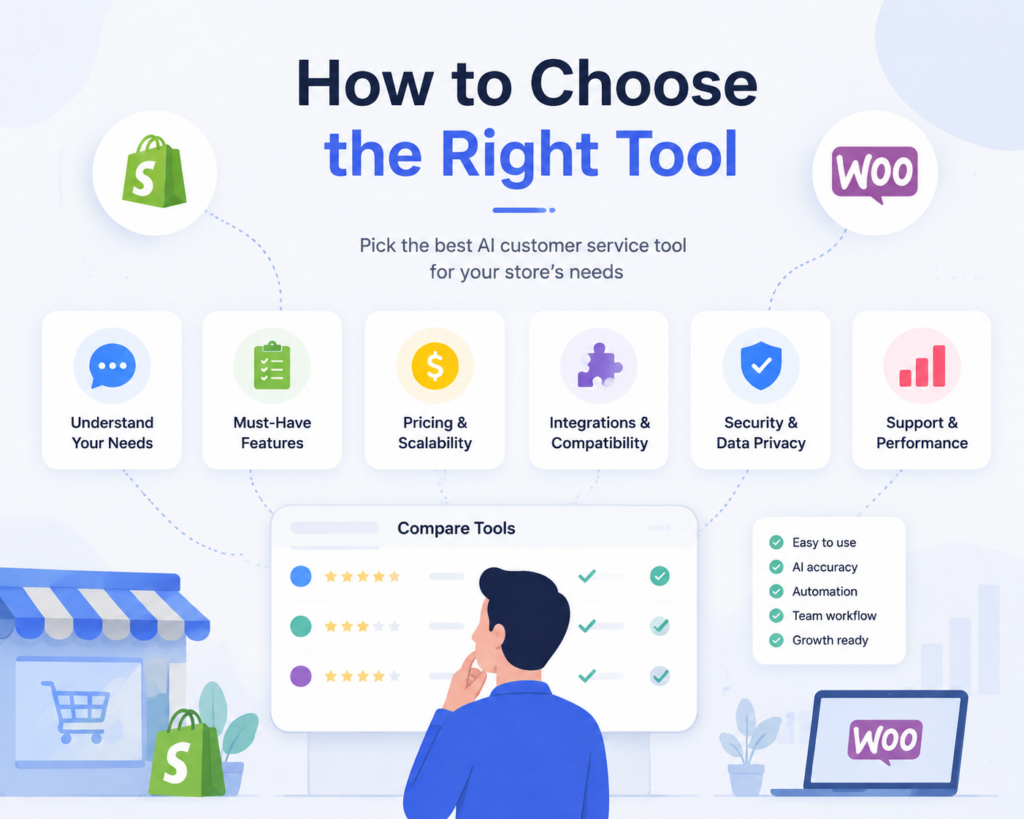
The best selection process starts with support problems, not software brands.
Begin by listing the most common customer questions from the last month. Then separate them into three groups: questions that only need information, questions that require store data, and questions that require an action.
For example, “What is your return policy?” only needs approved knowledge. “Where is my order?” needs order or tracking data. “Please cancel my order” may require an authenticated action.
Then evaluate:
This method makes product comparisons easier because every feature is connected to a real operational need.
A small store receiving a few dozen questions each week may need little more than an intelligent chat assistant. A growing direct-to-consumer brand receiving hundreds or thousands of monthly conversations may need routing, automation, order management, analytics, and multi-agent collaboration.
The most powerful platform is therefore not automatically the best platform.
The best choice is the one that removes the specific bottlenecks affecting the store today while leaving enough room for future growth.
AI support should be introduced in stages.
Start with low-risk questions such as shipping policies, basic product information, care instructions, and standard return rules. Review conversations frequently and correct weak knowledge sources.
Next, connect product and order information. Test common real-world scenarios before expanding access.
After that, add carefully controlled actions. A store may allow AI to check order status automatically but require a human for unusual refunds or exceptions.
Human escalation rules should also be established early. Customers should have a clear route to a person when the AI cannot confidently resolve the problem.
Finally, measure results.
Useful metrics include:
The goal is not to maximize the number of conversations handled by AI.
The real goal is to solve more customer problems accurately with less unnecessary effort.
One common mistake is launching AI with outdated information. An assistant cannot produce consistently reliable answers from inconsistent policies.
Another is giving AI too much authority too early. Order changes, refunds, and exceptions need clear limits.
A third mistake is hiding the path to a human. Customers become frustrated when automation becomes a barrier instead of a shortcut.
Merchants should also avoid choosing software based only on a polished demo. The real test is how the tool performs with the store’s own products, policies, apps, languages, and unusual customer situations.
Another mistake is expecting AI to correct a poorly organized support system automatically.
If return policies are unclear, shipping information is scattered across multiple pages, or product specifications conflict with each other, an AI assistant may simply reproduce those problems faster.
Cleaning up the store’s knowledge base should therefore be part of any AI customer-service project.
Finally, total cost matters.
Some platforms charge by agent, conversation, AI resolution, feature tier, or add-on. Because AI pricing models change quickly, merchants should calculate costs at both current and future support volume rather than focusing only on the advertised starting price. The source article similarly recommends checking current vendor pricing before making a purchase decision.
Ecommerce AI is moving from answering questions toward completing workflows.
For Shopify and WooCommerce merchants, customer-service software will increasingly overlap with sales assistance, product discovery, order management, and retention.
Instead of asking a shopper to browse several category pages, an AI shopping assistant may help narrow down products conversationally.
Instead of telling a customer where to find tracking information, an integrated AI agent may retrieve the relevant order details automatically.
Instead of transferring a long conversation without context, the system may summarize the issue before a human agent takes over.
The strongest systems will therefore not simply generate fluent text. They will combine accurate store knowledge, real-time commerce data, controlled actions, and effective human escalation.
That shift also makes governance more important.
As AI receives access to more customer and order information, merchants need stronger rules around permissions, privacy, review, and accountability.
The future of ecommerce customer service is unlikely to be completely automated or completely human. It is more likely to involve AI handling high-volume, predictable tasks while human teams concentrate on situations where judgment, empathy, negotiation, and business decisions matter most.
AI-powered customer service tools for Shopify و ووكومرس can reduce repetitive work, improve response speed, help shoppers find products, and give support teams better access to ecommerce context. But the right tool depends on much more than the quality of its chatbot.
Shopify merchants may prefer deeply integrated apps or Shopify-native tools, while WooCommerce merchants need to pay additional attention to plugin compatibility and configuration. Cross-platform options such as Tidio, Gorgias, and Re can be useful when a business needs a consistent support approach across different ecommerce environments.
The most effective strategy is to begin with real customer questions, define what AI may and may not do, test the system with actual store data, maintain an easy human handoff, and measure the quality of resolved conversations over time.
AI should make ecommerce customer service faster, more consistent, and easier to scale without sacrificing accuracy, control, or the overall customer experience.
1. What are AI-powered customer service tools for Shopify and WooCommerce?
AI-powered customer service tools are smart support solutions that use artificial intelligence to answer customer questions, automate conversations, provide product information, and help ecommerce stores manage support tasks more efficiently.
2. How can AI customer service tools improve an ecommerce store?
AI customer service tools can reduce response times, handle repetitive questions, provide 24/7 assistance, improve customer satisfaction, and allow support teams to focus on more complex customer issues.
3. Can AI customer service tools access Shopify and WooCommerce store data?
Many AI support tools can connect with Shopify or WooCommerce data, allowing them to provide information about products, inventory, orders, shipping, and customer inquiries. Available features depend on the specific platform and integration.
4. Can AI chatbots replace human customer support agents?
AI chatbots are designed to assist customer service teams rather than completely replace them. They work best for handling common questions while human agents manage complex issues that require judgment and personal communication.
5. What features should businesses look for in an AI customer service tool?
Important features include accurate knowledge management, ecommerce integrations, automated workflows, human handoff options, multi-channel support, reporting tools, and the ability to scale as the business grows.
6. How do I choose the right AI customer service tool for my Shopify or WooCommerce store?
Businesses should evaluate their customer support volume, common customer questions, required integrations, automation needs, budget, and future growth plans before selecting an AI customer service solution.